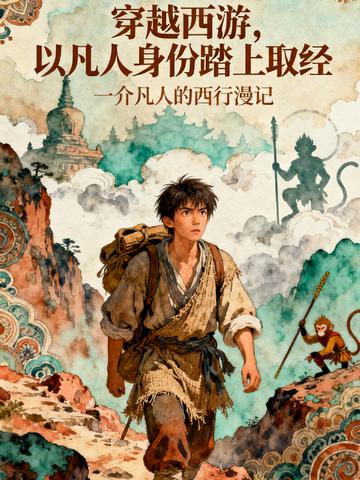
When Shen Yan, an urban young man who had memorized "Journey to the West" by heart, accidentally fell into the real world of Journey to the West - without the blessing of the system and the awakening of spiritual roots, he was just a mortal with no power to bind a chicken.
The gods and demons here no longer stay on the page, and the calculations of immortals and Buddhas are undercurrent. The only thing Shen Yan has is a deep memory of the original context and a sober modern soul.
📖 Knowledge is the only "magic weapon" for mortals - not relying on killing monsters to upgrade, relying on insight and decision-making
🌱 The silent transformation from "a bystander who knows the outcome" to a "guardian who participates in the fate"
🕯️ In the game between gods and demons, witness the tenacity and fragility of the team after the halo has faded.
🌌 When modern rationality collides with mythical logic: those "ifs" and "shoulds" that were not written in the original work
He used his pen as his eye and his heart as his inkstone to record the pain and glimmers covered by golden light in the gaps of myths.
As the Nine-Nine-Eighty-One Dilemma approached its end, Shen Yan finally discovered that what he was writing was not the Journey to the West, but the "Record of Human Practice" about how every ordinary life held the light and illuminated the way home in the grand narrative.
Reader comments
This book is okay. If you can calm down, you can read it. It's not a cool novel. It feels like you encounter something in life and then write something to express something. It's quite emotional. It seems that the author is a person who has a long-cherished wish for life.
The more I read this novel, the more interesting it becomes. There is a debate between Tang Seng and Shen Yan about good and evil. It is different from the pure pedantry of Tang Seng in the original work, and it creates an image of a real holy monk in Tang Seng. The growth and changes of Sun Wukong are also well written, from being unruly at the beginning to being confused between the real and fake Monkey King. This writing has a different feeling from the original work, making it easier for people to feel the change in mentality. The only drawback is that the description of the protagonist is not very useful, and only the changes of Tang Monk and Sun Wukong are focused on, while the descriptions of Zhu Bajie and Monk Sha are too little. Since we want to write about the changes in the Buddhist team, we must describe more about each character. At present, Zhu Bajie still looks lazy, lazy, and unmotivated, while Sha Seng always looks honest and humble, and cannot understand the changes between the two of them.
This book is okay. If you can calm down, you can read it. It's not a cool novel. It feels like you encounter something in life and then write something to express something. It's quite emotional. It seems that the author is a person who has a long-cherished wish for life. The more I read this novel, the more interesting it becomes. There is a debate between Tang Seng and Shen Yan about good and evil. It is different from the pure pedantry of Tang Seng in the original work, and it creates an image of a real holy monk in Tang Seng. The growth and changes of Sun Wukong are also well written, from being unruly at the beginning to being confused between the real and fake Monkey King. This writing has a different feeling from the original work, making it easier for people to feel the change in mentality. The only drawback is that the description of the protagonist is not very useful, and only the changes of Tang Monk and Sun Wukong are focused on, while the descriptions of Zhu Bajie and Monk Sha are too little. Since we want to write about the changes in the Buddhist team, we must describe more about each character. At present, Zhu Bajie still looks lazy, lazy, and unmotivated, while Sha Seng always looks honest and humble, and cannot understand the changes between the two of them.