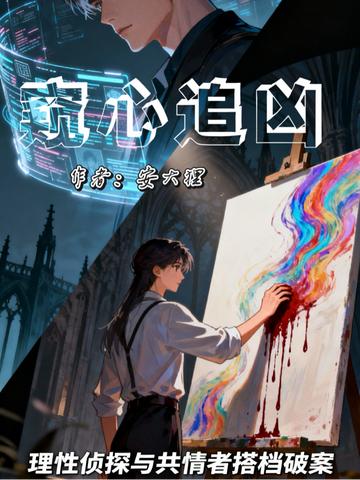
Due to a bizarre murder, criminal psychologist Lu Chen targeted the gallery owner Su Wan. She may seem weak, but she can accurately tell details that even the police don't know. In order to protect herself, Su Wan had to confess her deep secret: she has the ability of synesthesia and empathy, and can sense the strong emotions remaining on objects through touch.
Lu Chen was shocked by this "unscientific" ability, but was keenly aware that it was the key to solving the unsolved case. He offers a dangerous deal: She will help him track down the killer as a special consultant, and he will provide legal cover for her abilities. The two form an alternative partner. She uses her heart as a mirror to reflect the emotional fragments of the crime scene; he uses logic as a ruler to measure the deep labyrinth of human nature.
From the Blood Gallery to the Internet Abyss, they worked together to solve a series of cases intertwined with human distortions and social pain points, but found that behind each case, there was a shadow called the "Temple" looming. This organization, composed of highly intelligent criminals, is using the entire city as the stage for its cruel social experiment.
And when Su Wan comes across the final truth about Lu Chen's most respected mentor, their trust and emotions also face the ultimate test. In the collision of reason and sensibility, in the choice between abyss and redemption, they must work together to uncover the most perfect disguise, let the truth be revealed, and let love become the deepest redemption.
Reader comments
"Thunder in the Silence, Seeing the Universe in the Twilight - Comment on Narrative Art and Humanistic Depth"
Clothed in science fiction, it contains the skeleton of classical tragedy and the soul of humanism. The author uses cold and poetic writing to lay out a battlefield about the invasion of consciousness and the persistence of human nature. Su Wan's "empathy" turned from a gift to a curse, and then to nirvana as a weapon, and his mental journey was described as delicately as a rubbing of nerves; while Lu Chen's protection with reason as a blade and silence as a shield interprets another kind of affection that is almost martyrdom. The image of "door" in the book is multiple and intertwined - it is not only the door of the delusions of technological madmen, but also the sealed door of historical sins, and it is also the door of redemption for human nature to question itself on the edge of the abyss. The author is good at using restrained and precise details (such as pothos, matcha rolls, and unsent amulets) to add warmth to the cold-toned science fiction narrative, so that the grand apocalyptic fable finally falls into the glimmer of light that flows silently when the two stand side by side. This work not only tells the end of a battle, but also opens the prelude to an eternal battle: when technology is enough to tamper with the soul, humans can only recognize each other by their incomplete warmth. Where the still water flows deeply, the thunder is faint, which is the charm of this book.
"Thunder in the Silence, Seeing the Universe in the Twilight - Comment on Narrative Art and Humanistic Depth" Clothed in science fiction, it contains the skeleton of classical tragedy and the soul of humanism. The author uses cold and poetic writing to lay out a battlefield about the invasion of consciousness and the persistence of human nature. Su Wan's "empathy" turned from a gift to a curse, and then to nirvana as a weapon, and his mental journey was described as delicately as a rubbing of nerves; while Lu Chen's protection with reason as a blade and silence as a shield interprets another kind of affection that is almost martyrdom. The image of "door" in the book is multiple and intertwined - it is not only the door of the delusions of technological madmen, but also the sealed door of historical sins, and it is also the door of redemption for human nature to question itself on the edge of the abyss. The author is good at using restrained and precise details (such as pothos, matcha rolls, and unsent amulets) to add warmth to the cold-toned science fiction narrative, so that the grand apocalyptic fable finally falls into the glimmer of light that flows silently when the two stand side by side. This work not only tells the end of a battle, but also opens the prelude to an eternal battle: when technology is enough to tamper with the soul, humans can only recognize each other by their incomplete warmth. Where the still water flows deeply, the thunder is faint, which is the charm of this book.