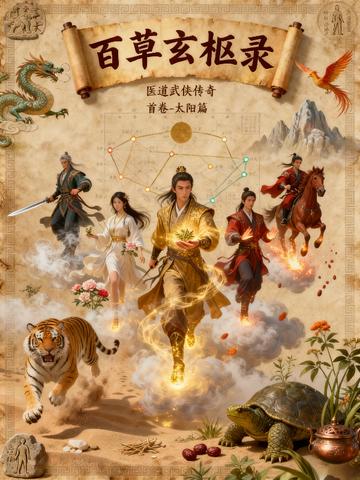
This is not only a fantasy journey in pursuit of the origin of medicine, but also a magnificent epic that promotes the culture of traditional Chinese medicine. Witness the magic of the spirit of plants and trees in the light of swords and shadows, and comprehend the corresponding principles between heaven and man in the changes in scriptures. When the last medicine spirit returns, what awaits them is not only the truth of a shocking conspiracy, but also the immortal wisdom that has been passed down for thousands of years in traditional Chinese medicine.
"Baicao Xuanshu Lu" - writes the true meaning of medicine with legendary pen and ink, and uses fantasy stories to inherit the essence of traditional Chinese medicine. Here, every medicinal material has its own soul, and every prescription hides a legend.
Reader comments
"Xuanshu Lu of Materia Medica" builds a "Materia Medica" with stunning creativity. It uses the articles of "Treatise on Febrile Diseases" as martial arts secrets, and transforms 365 medicinal materials into medicinal spirits knights with different temperaments. Ephedra is as strong as a swordsman, rhubarb is as bitter and cold as a swordsman, and cinnamon twigs are as harmonious as a gentleman - the meridian distribution of nature and flavor in medical theory is here transformed into the character's bloodline, and the Taoist area has become the origin of the sect. The author uses "differentiation of classics and prescriptions" as the core to weave the eternal duel between the medicine spirit and the medicine demon. Every medical case is a life and death arena, and every article contains a solution. This is not only a strange change in martial arts novels, but also a narrative translation of the wisdom of traditional Chinese medicine, allowing the four qi and five flavors to be reborn in the light of swords and shadows, and allowing the yin and yang and five elements to manifest in the grievances and grievances of the rivers and lakes. When Guizhi understands "two-way regulation" and when Rhubarb awakens to the "true meaning of the whole nature", medical science is no longer an obscure scripture, but becomes a majestic epic about balance, sacrifice and protection. This book can be called the pioneering work of "TCM martial arts". It uses magnificent imagination to energize Qihuang's skills, and inherits the thousands of years of medical history in the joyful grudges.
Come on, come on, come on💪
This book is well written, you can read it in the Xiuxian version of Treatise on Febrile Diseases
"Xuanshu Lu of Materia Medica" builds a "Materia Medica" with stunning creativity. It uses the articles of "Treatise on Febrile Diseases" as martial arts secrets, and transforms 365 medicinal materials into medicinal spirits knights with different temperaments. Ephedra is as strong as a swordsman, rhubarb is as bitter and cold as a swordsman, and cinnamon twigs are as harmonious as a gentleman - the meridian distribution of nature and flavor in medical theory is here transformed into the character's bloodline, and the Taoist area has become the origin of the sect. The author uses "differentiation of classics and prescriptions" as the core to weave the eternal duel between the medicine spirit and the medicine demon. Every medical case is a life and death arena, and every article contains a solution. This is not only a strange change in martial arts novels, but also a narrative translation of the wisdom of traditional Chinese medicine, allowing the four qi and five flavors to be reborn in the light of swords and shadows, and allowing the yin and yang and five elements to manifest in the grievances and grievances of the rivers and lakes. When Guizhi understands "two-way regulation" and when Rhubarb awakens to the "true meaning of the whole nature", medical science is no longer an obscure scripture, but becomes a majestic epic about balance, sacrifice and protection. This book can be called the pioneering work of "TCM martial arts". It uses magnificent imagination to energize Qihuang's skills, and inherits the thousands of years of medical history in the joyful grudges.
Come on, come on, come on💪
This book is well written, you can read it in the Xiuxian version of Treatise on Febrile Diseases