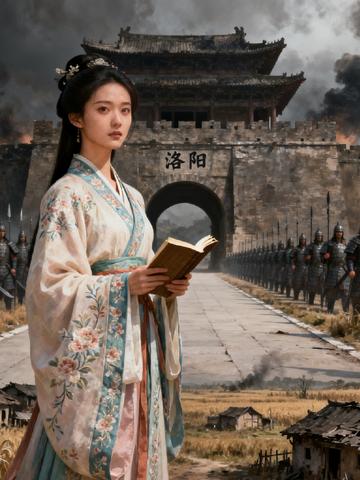
Lin Xiao, a 26-year-old administrative assistant, is the quintessential “invisible” office worker: introverted and sensitive, she always blames herself, and hardly anyone notices when she works overtime until she collapses. But an accident causes her to transmigrate as Cai Yan, also known as Cai Wenji, daughter of the late Eastern Han literary figure Cai Yong. The chaos of Dong Zhuo’s rebellion is just beginning, and the turbulent times sweep her away without warning.
From a modern office cubicle to the chaos of the Three Kingdoms, Lin Xiao carries memories of history, yet even her attempt to persuade her father to avoid disaster hits a wall because “women must not meddle in politics.” Forced to learn first aid while fleeing, teach farming techniques among the Xiongnu, and showcase her talents in the literary circles of Ye, she gradually transforms from a timid girl who runs from trouble into an independent woman who can read the balance of power in a succession struggle and defend herself against rumors.
Told from Lin Xiao’s (Cai Yan’s) perspective, the story connects historical milestones such as Dong Zhuo’s forced relocation of the capital, Cai Yong’s death, and Wenji’s return to Han territory. It depicts the hardships endured by ordinary people in troubled times while revealing the historical forces behind the choices of figures such as Cao Cao and Cao Pi. Across 800,000 words and ten volumes, the story offers the thrill of an ordinary person turning her life around, while also exploring profound questions about self-worth and the choices people make in history. As readers follow the protagonist’s growth, they come to see that “every historical figure’s choices are the product of the times and their fate.”