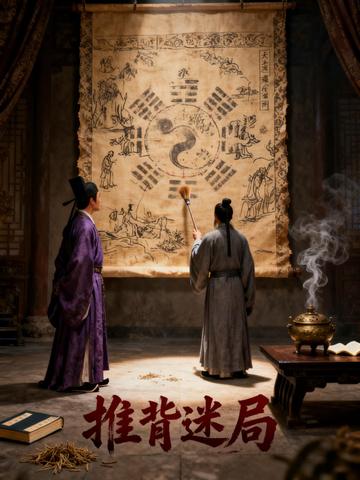
During the Zhenguan period of the Tang Dynasty, Taishi ordered Li Chunfeng and Yuan Tiangang to follow Taizong's order to use mystical skills to deduce the fate of the country and write the "Tuibei Diagram", which was named after Yuan Tiangang pushed the back to calculate. In his later years, Li Chunfeng was worried that future generations would abuse it, so he devoted all his efforts to write the final annotation "Xuan Jie", explaining the secrets and warnings of the deduction, and asked his close friends, the Li family, to protect it from generation to generation. It cannot be opened unless it is destined by destiny.
Time passed to the middle and late Ming Dynasty, and the court was in turmoil. Emperor Jiajing was obsessed with immortality and neglected his political power. There was an undercurrent of power struggle between the civil servant group and the eunuchs. At this time, the secret of "Xuanjie" reappearing in the human world spreads - it can provide insight into the whole "Tuibei Tu", and it can also reveal the secrets of heaven, control the situation of the government and even change the destiny. "Xuanjie" became the core of the power game: the emperor wanted to use it to consolidate his imperial power and seek immortality; the civil servant group hoped to limit the imperial power and attack the eunuchs; the eunuchs in charge of the ceremonial department tried to control the lifeline of the empire through prophecies.
Around the "Xuanjie" guarded by the descendants of the Li family, a battle intertwined with historical dust, court strife, five elements of evil and family grievances suddenly unfolded. The three forces each have their own hidden agendas, searching for treasures, exploring caves, solving puzzles, and working step by step amid the prophecies coming true and the changes in people's hearts.
"Tui Bei Puzzle" is based on a rich history, and combines the thrill of tomb robbing and treasure hunting with the thrilling suspense of solving puzzles. It deeply explores the corrosion of human nature by the desire for power, and uncovers the thousand-year-old fog of "Tui Bei Tu".