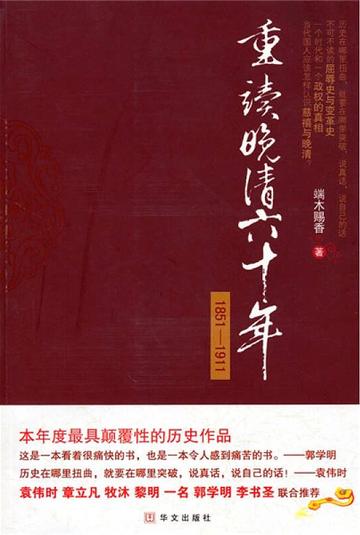
How should people in modern China understand Empress Dowager Cixi and the late Qing Dynasty?
In 1860, after 3,000 years of historical cycles in ancient China, Xianfeng, the tenth emperor of the Qing Dynasty, died. His consort Cixi joined forces with Prince Gong, Yixin, to crush the Eight Regents led by Sushun, beginning her fifty-year career of holding China together through a time of crisis.
"Ignorant and conservative" seems to be the fixed impression people have of Cixi. Yet during the Self-Strengthening Movement, she rebuked the Neo-Confucian scholar Woren, showing herself to be open to and accepting of Western civilization. She supported the Western-style arms and equipment reforms, appointed Han Chinese officials on a large scale, and counted such remarkable men of their age as Zeng Guofan, Li Hongzhang, and Zuo Zongtang among her officials, bringing about the "Tongzhi Restoration."
The First Sino-Japanese War, a foreign conflict entangled with an internal power struggle among the upper ranks, earned Cixi an eternal infamy. But with the Guangxu Emperor and his tutor Weng Tonghe hoping to use a war to seize the reins of government, whether to fight or seek peace became a dilemma for Cixi. The war was lost not because of Cixi, but because the Self-Strengthening Movement had not gone far enough.
During the radical Hundred Days' Reform, Cixi held back. Although the reforms were abolished because of her, the idealistic Kang Youwei, who ignored the realities of the situation, was clearly unfit to lead a national transformation.
In 1900, Prince Duan Zaiyi misled Cixi in pursuit of the throne. To protect her power, Cixi "invited" the Boxers to fight the foreign powers. A shrewd political strongwoman was ultimately narrowed by her lust for power and led astray.
During the final decade of the Qing Dynasty, the New Policies, led by Cixi and experienced officials, set China on the path to modernization. But as the death knell sounded for the feudal empire, the old man of history opened a new chapter...





There are many discrepancies in the facts and lack of verification. They are all based on what others say. In addition, this author is particularly mean when describing women. It is said that most of the people who are mean to women are women. It's really true.