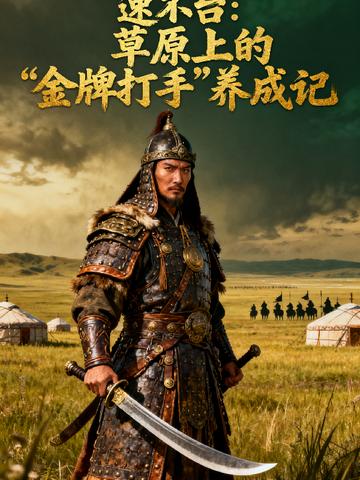
Subotai: The development story of a "gold medal fighter" on the grassland
Subotai was born in the Ulyanha Tribe of Mongolia. He followed Genghis Khan as a slave in his early years. He distinguished himself with his superior riding, archery and strategy, and became one of the "Four Mastiffs", starting a legendary military career.
During the period of unifying the Mongolian Plateau, he repeatedly made extraordinary achievements: he was the first to ascend the city when he attacked Huanzhou, and he used clever tactics to annihilate the Merqi tribe. He was steadily promoted from the head of a hundred households to the head of a thousand households, laying the foundation of a "warrior". After following Genghis Khan's western expedition, he teamed up with Jebe to pursue the Khwarezm monarch Mahamo to the Caspian Sea, swept across Persia and the Caucasus, and traveled all over Central Asia with his iron cavalry.
After Wokuotai came to power, Subotai became the key to destroying the Jin Dynasty: in the Battle of Sanfeng Mountain, he commanded an army to annihilate the 150,000 main force of the Jin Army, and finally led the army to conquer Caizhou, completely ending the rule of the Jin Kingdom. During the second Western Expedition, he assisted Batu in the expedition, captured the leader of the Kipchak tribe, defeated Russia, Poland, Hungary and other countries, and shocked Europe and Asia with his troops reaching the Danube River.
In his more than 40 years of fighting career, Subotai used flexible tactics to conquer the battlefield without ever losing. In his later years, he chose to resign and return to his hometown, and eventually died of illness at the age of 73. He used his cavalry and meritorious deeds throughout his life to write the counterattack epic of the "Gold Medal Fighter" on the grassland from a slave to a legendary commander in Europe and Asia.