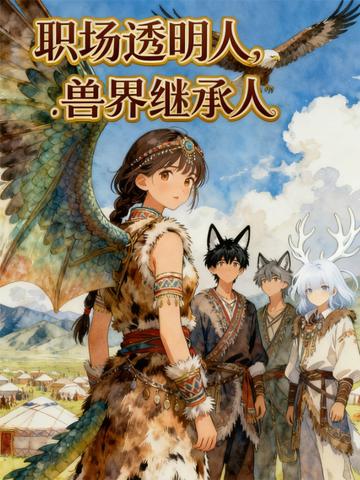
Lin Ran worked as a "transparent person" in the pantry of an office building for three years - he was robbed of credit for his plans, his salary was subsidized by his family, and even when he bought a cup of strawberry yogurt, he had to write it down in the corner of the post-it note to remind himself. Until that late night when the battery ran out, the moment the golden prompt box popped up, she fell into a strange world full of animal skins and totems.
When she opened her eyes again, she became "Cang Ran", a cub of the Cang clan's orc tribe, an heir who had not yet awakened to her beast form at the age of two and was secretly mocked as a "waste cub" by her tribe. The palms of my hands are no longer the cold keyboard, but the warmth of swaddled animal skins; the ears are no longer the gossips of colleagues, but the instructions of the mother of the Black Panther leader: "Your worth will never be proven by the shape of an animal."
When the "survival rules" in the workplace collide with the "survival crisis" in the animal world, the wisdom of social animals suddenly comes into play: using the triangle bracket principle to build rainproof rooms, using report logic to plan hunting routes, and using cross-department collaboration ideas to form an orc alliance. She took the black fox think tank Mo Chen and the winged wolf pioneer Liefeng, and stepped on the label of "waste cub" under her feet amidst drought and surrounded by foreign enemies.
And every time she grew up in the animal world, she was quietly changing reality - Lin Ran, who didn't even dare to refute, began to argue with reason in meetings; the "tool man" who was used to wronging himself, learned to say "no" to unreasonable demands.
The gears of the two worlds rotated synchronously, when the "key to the two worlds" of the animal world shimmered, and when the real workplace crisis struck again, she finally understood: the so-called growth is never a one-way salvation, but a self in both worlds, living as if they dare to clench their fists