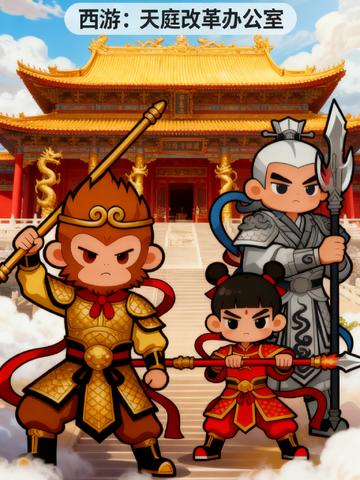
After the chaos in the Heavenly Palace, the sea, and the mother-saving incident, in order to appease these three "thorns", the Heavenly Court established a department called the "Heavenly Court Reform Office". In name, it allowed them to "use their remaining energy," but in fact it wanted to marginalize them. Sun Wukong is the director, Yang Jian is the deputy director (he listens to orders but not announcements, and only appears at critical moments), and Nezha is the action team leader.
Heaven's ten thousand years of rules and regulations cannot suppress three rebellious hearts! Sun Wukong makes trouble in the Heavenly Palace, Yang Jian defies heaven's rules, and Nezha burns immortal books. The three most troublesome rebels in the three worlds unexpectedly form an alliance.
They broke the destiny script established by gods and Buddhas, overthrew the hypocritical order of Lingxiao Palace, and used golden cudgels, three-pointed two-edged knives, and fire-tipped spears to tear open the prison of heaven.
Immortals and gods are afraid, demons are in awe, let's see how these three "heavenly aliens" overturn the structure of the three realms and blaze a path that only belongs to them!
Reader comments
"Journey to the West: Heavenly Court Reform Office" is an imaginative and unique novel about Journey to the West. The author skillfully combines traditional mythology with modern workplace and institutional reforms to construct a heavenly world that is both familiar and novel. The story revolves around the core organization of the "Reform Office", taking the institutional innovation, power game and the workplace ecology of the gods as the main thread, injecting new vitality into the ancient Journey to the West story.
The most attractive part of the novel is its unique worldview setting. Heaven is no longer a lofty and immutable theocratic institution, but is full of see-saws between reform and conservatism, innovation and conservatism. In the process of promoting the reform of Heavenly Court, the protagonist (or team) not only has to face resistance from all forces, but also has to deal with various unexpected "magic events", and even has to coordinate the "project progress" of the team to learn from the experience. This kind of creativity that combines mythology with modern management concepts is eye-catching.
In terms of character creation, the author gives traditional gods more diverse and three-dimensional personalities. Great gods such as the Jade Emperor, Taishang Laojun, and Guanyin are no longer symbolic existences, but "professional people" with their own positions, interests, and worries. The members of the Reform Office have also grown and transformed through project advancement and crisis management, showing wisdom, courage and responsibility.
In terms of plot, the novel has both grand reform narratives and delicate daily descriptions. From policy formulation to departmental collaboration, from gods descending to the earth to demons being punished, every story closely follows the theme of "reform" without losing the fantasy and sense of humor of Journey to the West. Readers can not only feel the difficulty and complexity of reform within the system, but also understand the confusion and persistence of the gods when facing new challenges.
"Journey to the West: Heavenly Court Reform Office" is not only a highly entertaining novel, but also a thoughtful work. It uses the shell of myth to explore real-world topics such as institutional innovation, teamwork, and personal growth, allowing readers to enjoy reading and get some inspiration at the same time.
In short, this is an excellent work full of creativity, fast pace, and vivid characters. It is worth reading for all readers who like Journey to the West themes and workplace stories.
"Journey to the West: Heavenly Court Reform Office" is an imaginative and unique novel about Journey to the West. The author skillfully combines traditional mythology with modern workplace and institutional reforms to construct a heavenly world that is both familiar and novel. The story revolves around the core organization of the "Reform Office", taking the institutional innovation, power game and the workplace ecology of the gods as the main thread, injecting new vitality into the ancient Journey to the West story. The most attractive part of the novel is its unique worldview setting. Heaven is no longer a lofty and immutable theocratic institution, but is full of see-saws between reform and conservatism, innovation and conservatism. In the process of promoting the reform of Heavenly Court, the protagonist (or team) not only has to face resistance from all forces, but also has to deal with various unexpected "magic events", and even has to coordinate the "project progress" of the team to learn from the experience. This kind of creativity that combines mythology with modern management concepts is eye-catching. In terms of character creation, the author gives traditional gods more diverse and three-dimensional personalities. Great gods such as the Jade Emperor, Taishang Laojun, and Guanyin are no longer symbolic existences, but "professional people" with their own positions, interests, and worries. The members of the Reform Office have also grown and transformed through project advancement and crisis management, showing wisdom, courage and responsibility. In terms of plot, the novel has both grand reform narratives and delicate daily descriptions. From policy formulation to departmental collaboration, from gods descending to the earth to demons being punished, every story closely follows the theme of "reform" without losing the fantasy and sense of humor of Journey to the West. Readers can not only feel the difficulty and complexity of reform within the system, but also understand the confusion and persistence of the gods when facing new challenges. "Journey to the West: Heavenly Court Reform Office" is not only a highly entertaining novel, but also a thoughtful work. It uses the shell of myth to explore real-world topics such as institutional innovation, teamwork, and personal growth, allowing readers to enjoy reading and get some inspiration at the same time. In short, this is an excellent work full of creativity, fast pace, and vivid characters. It is worth reading for all readers who like Journey to the West themes and workplace stories.