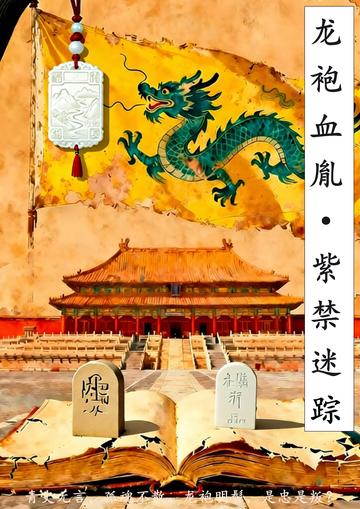
Three hundred years of Qing history, riddled with unofficial tales. A dynastic secret wrapped in a dragon robe, an identity mystery spanning three centuries. In 2006, a three-hundred-year-old coffin was unearthed at a construction site on Yuquan Road in Shijingshan, Beijing. Inside lay a mummified body dressed in a first-rank military official's qilin insignia robe, with a five-clawed dragon robe underneath. Its hair was styled in a Ming fashion, and a jade pendant at its waist was engraved with the words “May blessings endure.” Yet the inscription inside the coffin read, “Huang Gong Chuwu, bestowed with the title of Zhongxian Grand Master by the Great Qing,” identifying a fourth-rank civil official unknown to history. The deceased had six toes on his left foot and a face uncannily like the Kangxi Emperor's. The pearl court necklace buried with him was fit for a prince, and a Kangxi Tongbao coin fixed the date at the twenty-third year of the Kangxi reign. At that moment, the Qing historical record's accounts of the hair-shaving order, dress codes, and imperial clan burial rites all came crashing down.
According to the history books, in the fifth month of the eighth year of the Kangxi reign, the young emperor captured the powerful minister Oboi, ushering in an age of prosperity. But few know that Oboi once roared in Manchu from his prison cell, “Xuanye is a fake! He is no son of Aisin Gioro!” The guards did not understand Manchu and recorded his words only as “wails of remorse.”
A hidden past now came to light: In the eighteenth year of the Shunzhi reign, the fourth prince born to Consort Donggo died in infancy. To secure the dynasty, Empress Dowager Xiaozhuang secretly ordered Hong Chengchou to substitute his Han grandson for the third prince. The real Xuanye had already died outside the palace. The dragon robe and Ming-style hair were his final stand for his Zhu Ming bloodline. And could his resemblance to the Kangxi Emperor be an accidental clue to the Qing court's deception? History is written by the victors, but corpses do not lie. As archaeologists brush the dust from the dragon robe, a suppressed dynastic secret begins to tear open the seals on the official histories... The history books are silent, but the lonely spirit remains. The dragon robe and Ming-style hair: loyalty or betrayal?