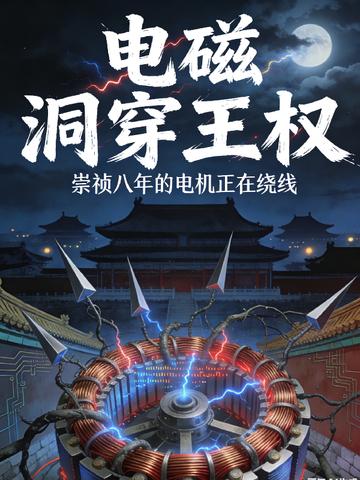
Chen Beichen, an electrical engineer in the 21st century, travels back in time to the tenth year of Wanli in the Ming Dynasty with a military-grade power backpack. At that time, Zhang Juzheng died of illness, the government was in turmoil, and Japanese pirates were raging in the southeast. Relying on electromagnetic technology, he, Shen Yanshu, a talented woman from the Ministry of Industry, and Zhao Tiezhu, a retired soldier, first showed their power with "Sky Thunder" on the banks of the Qiantang River and established the Equipment Preparation Bureau.
From the eradication of Japanese pirates and North Korea's resistance to Japanese aggression, to court games and technological revolution, Chen Beichen used electricity as a spear and worked step by step: electromagnetic cannons blasted open the gates of Pyongyang, telegraph machines reshaped the intelligence network, and armored ships fought decisively in Southeast Asia. Shen Yanshu broke the shackles and became the first female minister of the Ming Dynasty; Zhao Tiezhu forged the modern army. And the enemies in the dark - collaborators and traitors, Western colonists, conservative dignitaries - set up killing schemes one after another.
When the Spanish Armada approaches the border, the electromagnetic defense line confronts the sails and artillery; when the steam turbine and the difference engine race from east to west, a technological storm spanning four hundred years will completely subvert the dynastic order and ignite China's electromagnetic era. Hard-core technology integrates real history to see how modern wisdom carved a path to heaven on the battlefield of the Ming Dynasty.
Reader comments
"The God of Knowledge Under the Iron Sky"
When the last blue light of the electric arc extinguished in the night sky at the end of the Ming Dynasty, and when the black smoke of the first blast furnace rose from the wild mountain col, what we witnessed was not only the desperate survival of a modern soul, but also a cruel dimensionality reduction attack on the civilized dimension. The work "Electromagnetic Penetration of Kings", with its astonishing hard-core setting and profound historical speculation, blazes a completely different path in the vast sea of time-travel themes - it does not recite poetry, copy lyrics, or climb the technological tree, but forges the "scientific methodology" itself into the most powerful artifact that subverts the times.
Science is divine power: Goldfinger's philosophical dimensionality
The most shocking breakthrough of this book is that it completely abandons superficial "knowledge transfer". What the protagonist Chen Beichen carries is not a specific formula or blueprint, but a scientific worldview and engineering thinking paradigm. He used electrolytes and triboelectricity to create "thunder" from death row, practiced "standardization" and "quality control" using home-made blast furnaces in barren mountains, and relied on basic physical and chemical knowledge to dismantle and reconstruct the world in front of him. Every technological breakthrough is a systematic project of logical deduction, experimental trial and error, and resource allocation. This is not "cheating", but forcibly installing another civilization's operating system on this "old machine" that is on the verge of collapse in the late Ming Dynasty. When "the study of things and principles" becomes a new belief, and "the laws of physics" become the new destiny, the spiritual impact it brings is far more fundamental and terrifying than a few Song poems or a few flintlock guns.
It tells us that the most powerful plug-in for time travelers is not to predict history, but to hold the key to another universe - the scientific spirit and unyielding rationality. When Chen Beichen stood in the light of the first arc lamp, he illuminated not only the dark night of the late Ming Dynasty, but also the eternal belief in human wisdom and creativity in the hearts of countless readers.
This is not just a story about the last years of the Ming Dynasty.
This is a magnificent hymn dedicated to reason, creativity and unyielding will.
When the time traveler, electrical engineer Chen Beichen's father asked for a name, he said it from a scientific point of view. Polaris is the celestial navigation coordinates in the universe, and its stability represents the scientific and objective laws brought by the protagonist, which perfectly fits the theme of "physics is destiny". The name is majestic and the layout is broad.
The author seems to foreshadow the development of the story when introducing the protagonist's name, which also reflects the author's rigorous and solid writing style.
"Electromagnetic Penetration Kingship" is by no means another ordinary time-travel novel. It is like a precise and cold time machine that milled the absolute rationality of "electrical engineering" into the rotten wood of the last years of the Ming Dynasty.
"The motor of the eight years of Chongzhen is being wound up" - the subtitle is a perfect footnote to the spirit of the book. There was no instant success, no gun made out of thin air, only an engineer in the darkest era, starting from the first coil of copper wire and starting from the first furnace of coke. What readers witness is not a miraculous gift, but a rigorous, arduous, frustrating and exciting experiment in recreating civilization. While the Forbidden City was still wracked by party strife and border troubles, the fires in Heishi'ao were already glowing red in the sky, and the first electric sparks from the hand-cranked generator were the dawn of a new world.
The author uses solid engineering knowledge as the basis and the bloody historical facts of the late Ming Dynasty as the flesh to construct a logically self-consistent and detailed hard-core technological world travel. Here, science is the only oracle, the workshop is a brand-new temple, and the protagonist, holding a multimeter and design drawings, is using steel, electricity and organizational power to write a calm poem dedicated to the new industrial civilization.
This is not only a novel about conquest, but also a magnificent deduction about "how is it possible". When the last page is closed, you can seem to hear that at a certain node in the eight years of Chongzhen, the direction of the historical rails was moved by the quietly running motor.
It's getting more and more interesting to watch
The structure is very compact. Different from other time travel stories, the author has rigorous research and knowledge on the history of the late Ming Dynasty, including household registration, inns, taxation and other systems. The protagonist's system is not a borderless cheat, but is based on the historical status quo.
I found this book in Shu Huang. There are many novels that travel through the late Ming Dynasty. All kinds of cheats are also very imaginative. This kind of technology is still relatively rare. I give the author a big thumbs up.
Time travel plus science fiction, not the traditional return to the Ming Dynasty to build guns and cannons, it is highly recommended.
The plot is exciting, time travel➕science fiction, a good story that has been buried
The writing is compact and the stories are interlocking.
Five-star praise, time travel + science fiction
Still reading, very exciting
Five-star praise, the stories are interlocking, and the author's writing is compact. Still unfinished



"The God of Knowledge Under the Iron Sky" When the last blue light of the electric arc extinguished in the night sky at the end of the Ming Dynasty, and when the black smoke of the first blast furnace rose from the wild mountain col, what we witnessed was not only the desperate survival of a modern soul, but also a cruel dimensionality reduction attack on the civilized dimension. The work "Electromagnetic Penetration of Kings", with its astonishing hard-core setting and profound historical speculation, blazes a completely different path in the vast sea of time-travel themes - it does not recite poetry, copy lyrics, or climb the technological tree, but forges the "scientific methodology" itself into the most powerful artifact that subverts the times. Science is divine power: Goldfinger's philosophical dimensionality The most shocking breakthrough of this book is that it completely abandons superficial "knowledge transfer". What the protagonist Chen Beichen carries is not a specific formula or blueprint, but a scientific worldview and engineering thinking paradigm. He used electrolytes and triboelectricity to create "thunder" from death row, practiced "standardization" and "quality control" using home-made blast furnaces in barren mountains, and relied on basic physical and chemical knowledge to dismantle and reconstruct the world in front of him. Every technological breakthrough is a systematic project of logical deduction, experimental trial and error, and resource allocation. This is not "cheating", but forcibly installing another civilization's operating system on this "old machine" that is on the verge of collapse in the late Ming Dynasty. When "the study of things and principles" becomes a new belief, and "the laws of physics" become the new destiny, the spiritual impact it brings is far more fundamental and terrifying than a few Song poems or a few flintlock guns. It tells us that the most powerful plug-in for time travelers is not to predict history, but to hold the key to another universe - the scientific spirit and unyielding rationality. When Chen Beichen stood in the light of the first arc lamp, he illuminated not only the dark night of the late Ming Dynasty, but also the eternal belief in human wisdom and creativity in the hearts of countless readers. This is not just a story about the last years of the Ming Dynasty. This is a magnificent hymn dedicated to reason, creativity and unyielding will.
When the time traveler, electrical engineer Chen Beichen's father asked for a name, he said it from a scientific point of view. Polaris is the celestial navigation coordinates in the universe, and its stability represents the scientific and objective laws brought by the protagonist, which perfectly fits the theme of "physics is destiny". The name is majestic and the layout is broad. The author seems to foreshadow the development of the story when introducing the protagonist's name, which also reflects the author's rigorous and solid writing style.
"Electromagnetic Penetration Kingship" is by no means another ordinary time-travel novel. It is like a precise and cold time machine that milled the absolute rationality of "electrical engineering" into the rotten wood of the last years of the Ming Dynasty. "The motor of the eight years of Chongzhen is being wound up" - the subtitle is a perfect footnote to the spirit of the book. There was no instant success, no gun made out of thin air, only an engineer in the darkest era, starting from the first coil of copper wire and starting from the first furnace of coke. What readers witness is not a miraculous gift, but a rigorous, arduous, frustrating and exciting experiment in recreating civilization. While the Forbidden City was still wracked by party strife and border troubles, the fires in Heishi'ao were already glowing red in the sky, and the first electric sparks from the hand-cranked generator were the dawn of a new world. The author uses solid engineering knowledge as the basis and the bloody historical facts of the late Ming Dynasty as the flesh to construct a logically self-consistent and detailed hard-core technological world travel. Here, science is the only oracle, the workshop is a brand-new temple, and the protagonist, holding a multimeter and design drawings, is using steel, electricity and organizational power to write a calm poem dedicated to the new industrial civilization. This is not only a novel about conquest, but also a magnificent deduction about "how is it possible". When the last page is closed, you can seem to hear that at a certain node in the eight years of Chongzhen, the direction of the historical rails was moved by the quietly running motor. It's getting more and more interesting to watch
The structure is very compact. Different from other time travel stories, the author has rigorous research and knowledge on the history of the late Ming Dynasty, including household registration, inns, taxation and other systems. The protagonist's system is not a borderless cheat, but is based on the historical status quo.
I found this book in Shu Huang. There are many novels that travel through the late Ming Dynasty. All kinds of cheats are also very imaginative. This kind of technology is still relatively rare. I give the author a big thumbs up.
Time travel plus science fiction, not the traditional return to the Ming Dynasty to build guns and cannons, it is highly recommended.
The plot is exciting, time travel➕science fiction, a good story that has been buried
The writing is compact and the stories are interlocking.
Five-star praise, time travel + science fiction Still reading, very exciting
Five-star praise, the stories are interlocking, and the author's writing is compact. Still unfinished