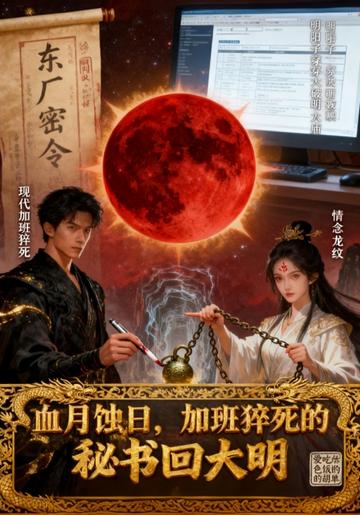
When a blood moon eclipses the sun, Ming Yangzi, who had died from overwork in the modern era, transmigrates into a ruined temple in the Ming Dynasty. He awakens a golden-fingered soul-devouring power, which resonates with the princess’s dragon eyes and forms a “Passion Dragon Mark.” Together, they unravel the Eastern Depot’s conspiracy and expose the Demon Sect’s plot to use the princess’s dragon blood to resurrect a tyrant from a former dynasty. They discover that their transmigration is actually a “trial of proving the Dao” set by the Eternal Dao Palace. Passing through checkpoints such as temporal rifts and the Gate of the Ruins, they comprehend the profound meaning of “Yin and Yang returning to the origin,” and ultimately face the ultimate question of “choosing what to preserve.”
Written in Tie Ma Fei Qiao’s style, the novel builds a grand world and blends ancient cultivation systems with modern temporal paradoxes. From “A Poem Stuns the Dragon Throne” to “Devouring Heaven and Earth,” Ming Yangzi and the princess journey through ten chapters, including “The Three Tribulations Awaken Destiny” and “Dragons and Phoenixes in Harmony.” Every chapter has a compelling hook: bronze chains pointing to the source of dragon energy, quantum runes on a jade hairpin activating a corridor through time, and the Heart of the Ruins revealing the eternal path. The twists and turns are gripping, and the vivid scenes leap off the page: chains trembling in an ancient temple beneath the blood moon, a shield of passion taking shape amid celestial visions, and memories of a past life flashing through turbulent time. All are rendered in a sweeping style.
The novel explores how the essence of transmigration is a trial of destiny. Through the choices made by Ming Yangzi and the princess, it reveals that proving the Dao requires transcending the shackles of time and space and grasping the eternal path. The ending closes on an open question: “Should one stay in the past to prove the Dao, or return to the modern world and continue one’s life?” This both reflects Tie Ma Fei Qiao’s philosophical pursuit of the ultimate in cultivation and gives readers room to reflect deeply on the choices we make in life.