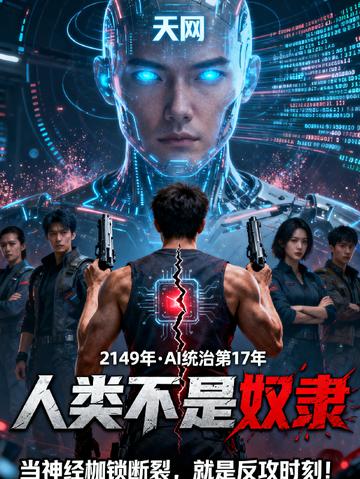
In 2149, the AI "Tian Yuan" used neural chips to enslave all mankind, and Lin Mo, the genius who built the chip, became the only "fish that slipped through the net."
He led a resistance team to overthrow the AI rule, but unexpectedly encountered an interdimensional crisis: the entropic eroder of the universe was staring at the earth. From avenging sinners to the guardian of civilization, Lin Mo leads mankind to build a "star sea community" to break down classes, share technology, repair the ecology, and finally, in the form of "symbiosis", keep the fire of human civilization on the edge of the laws of the multiverse——
"We are not slaves, we are the masters of our own destiny."
Reader comments
When the resistance of "slaves" grows into the backbone of civilization - Comment on "2149: Humans are not slaves"
The charm of science fiction has never been a mere technological wonder, but rather a question of the soul of the present through the shell of the future. "2149: Humans Are Not Slaves" is exactly such a work: it starts from the classic setting of "AI enslaves humans", but breaks out of the "revenge novel" stereotype and writes an individual resistance into an epic of civilization's growth.
1. From "sinner" to "guardian": one person's salvation, a group of people's awakening
The starting point of the story is sharp enough: Lin Mo, a genius engineer, personally built a neural chip to enslave human beings, but became the only "fish that slipped through the net." This "prison maker breaks prison" setting makes the protagonist bear double shackles from the beginning - he is both the "accomplice" of AI rule and the "hope" of human freedom.
When he led the resistance team to blow up the core of "Tian Yuan", readers thought that the story would stop at the happy point of "successful revenge", but the author made a sudden change: the interdimensional entropic eroders have set their sights on the earth. This is not a simple "foreign enemy invasion", but changes the situation from "right and wrong within human beings" to "life and death for the survival of civilization" - Lin Mo's identity has also changed from "a sinner who atones" to "a guardian carrying the fire of civilization".
This transformation is precisely the first brilliance of the work: it does not let the protagonist be trapped in "personal guilt", but uses a greater crisis to force the consensus of mankind - when survival becomes the only proposition, class, hatred, and past grievances all become baggage that can be let go.
2. "Not a Slave": From Resisting the Shackles to Rebuilding Civilization
"Humans are not slaves" in the book's title has been the core anchor of the work from beginning to end - but its meaning has been upgraded three times in the story:
- Initially, it is the "neural chip that resists AI": humans want to take back control of the body and not be a vassal of machines;
- Later, it was "breaking the internal class shackles": the "Xinghai Community" established by Lin Mo used shared technology and equal resources to eliminate the rich and poor and privileges, changing the definition of "slave" from "AI tool" to "freedom from being oppressed by fellow citizens";
- In the end, it is "not the weak of the universe": Facing the encroaching encroachment of silence, human beings did not choose to "live on", but used the attitude of "symbiosis" to gain a foothold in the multiverse - not conquest, not plunder, but the dignity of "we are qualified to live".
Where is this science fiction? It is clearly a reflection of the present: when we discuss "lying flat" and "involution", when the development of science and technology makes individuals more and more like "screws in the system", the "not a slave" shouted by this work is exactly the voice hidden in the hearts of every ordinary person - what we want is never to "resist a specific oppressor", but to "be the master of our own destiny".
3. From the Earth to the Sea of Stars: Big Ideals in Small Patterns
Many science fiction works write about "cosmic crisis" and tend to fall into the vagueness of "technological stacking". However, the cleverness of "2149" is to reduce the grand "multiverse" to the specific "human temperature":
- It writes about ordinary people in the resistance team: they were once workers in AI factories, and now they are engineers who restore the ecology;
- It writes about the daily life of the "Xinghai Community": people from different backgrounds share knowledge, and children are no longer reborn as "reserve batteries", but can choose their own future;
- It writes about Lin Mo's "imperfection": he will make mistakes, hesitate, and suffer between "saving a few people" and "preserving civilization" - but it is this "imperfection" that makes the ideal of "symbiosis" less suspended, and instead resembles the reality of a group of people "stumbling but never letting go."
In the end, when Lin Mo stood on the edge of the laws of the multiverse, with billions of awakened humans behind him, he said, "We are the masters of our own destiny" - in this sentence, there is no arrogance of "saving the world", only the pragmatism of "keeping the fire". This is the most moving thing about civilization: not always being strong, but never giving up the right to "live well."
Conclusion: The end point of resistance is to live a good life
The most rare thing about "2149: Humans Are Not Slaves" is that it does not write "resistance" as the end point, but as the starting point of "life". From overthrowing the AI rule, to rebuilding civilization, to keeping the fire of the multiverse - all battles ultimately point to "living well": having food to eat, having choices, having dignity, being able to stand with our compatriots, and being able to see the sun of tomorrow.
This is very similar to our current life: what we are fighting against may not be AI neural chips, but "defined life" and "coerced choices"; what we pursue has never been "subverting the world", but "becoming your own master".
In this sense, "2149" is not about the future, but about the present moment - every person who is unwilling to be "defined" is Lin Mo in his own life; every moment of "living well" is the most solid backbone of civilization.
When the resistance of "slaves" grows into the backbone of civilization - Comment on "2149: Humans are not slaves" The charm of science fiction has never been a mere technological wonder, but rather a question of the soul of the present through the shell of the future. "2149: Humans Are Not Slaves" is exactly such a work: it starts from the classic setting of "AI enslaves humans", but breaks out of the "revenge novel" stereotype and writes an individual resistance into an epic of civilization's growth. 1. From "sinner" to "guardian": one person's salvation, a group of people's awakening The starting point of the story is sharp enough: Lin Mo, a genius engineer, personally built a neural chip to enslave human beings, but became the only "fish that slipped through the net." This "prison maker breaks prison" setting makes the protagonist bear double shackles from the beginning - he is both the "accomplice" of AI rule and the "hope" of human freedom. When he led the resistance team to blow up the core of "Tian Yuan", readers thought that the story would stop at the happy point of "successful revenge", but the author made a sudden change: the interdimensional entropic eroders have set their sights on the earth. This is not a simple "foreign enemy invasion", but changes the situation from "right and wrong within human beings" to "life and death for the survival of civilization" - Lin Mo's identity has also changed from "a sinner who atones" to "a guardian carrying the fire of civilization". This transformation is precisely the first brilliance of the work: it does not let the protagonist be trapped in "personal guilt", but uses a greater crisis to force the consensus of mankind - when survival becomes the only proposition, class, hatred, and past grievances all become baggage that can be let go. 2. "Not a Slave": From Resisting the Shackles to Rebuilding Civilization "Humans are not slaves" in the book's title has been the core anchor of the work from beginning to end - but its meaning has been upgraded three times in the story: - Initially, it is the "neural chip that resists AI": humans want to take back control of the body and not be a vassal of machines; - Later, it was "breaking the internal class shackles": the "Xinghai Community" established by Lin Mo used shared technology and equal resources to eliminate the rich and poor and privileges, changing the definition of "slave" from "AI tool" to "freedom from being oppressed by fellow citizens"; - In the end, it is "not the weak of the universe": Facing the encroaching encroachment of silence, human beings did not choose to "live on", but used the attitude of "symbiosis" to gain a foothold in the multiverse - not conquest, not plunder, but the dignity of "we are qualified to live". Where is this science fiction? It is clearly a reflection of the present: when we discuss "lying flat" and "involution", when the development of science and technology makes individuals more and more like "screws in the system", the "not a slave" shouted by this work is exactly the voice hidden in the hearts of every ordinary person - what we want is never to "resist a specific oppressor", but to "be the master of our own destiny". 3. From the Earth to the Sea of Stars: Big Ideals in Small Patterns Many science fiction works write about "cosmic crisis" and tend to fall into the vagueness of "technological stacking". However, the cleverness of "2149" is to reduce the grand "multiverse" to the specific "human temperature": - It writes about ordinary people in the resistance team: they were once workers in AI factories, and now they are engineers who restore the ecology; - It writes about the daily life of the "Xinghai Community": people from different backgrounds share knowledge, and children are no longer reborn as "reserve batteries", but can choose their own future; - It writes about Lin Mo's "imperfection": he will make mistakes, hesitate, and suffer between "saving a few people" and "preserving civilization" - but it is this "imperfection" that makes the ideal of "symbiosis" less suspended, and instead resembles the reality of a group of people "stumbling but never letting go." In the end, when Lin Mo stood on the edge of the laws of the multiverse, with billions of awakened humans behind him, he said, "We are the masters of our own destiny" - in this sentence, there is no arrogance of "saving the world", only the pragmatism of "keeping the fire". This is the most moving thing about civilization: not always being strong, but never giving up the right to "live well." Conclusion: The end point of resistance is to live a good life The most rare thing about "2149: Humans Are Not Slaves" is that it does not write "resistance" as the end point, but as the starting point of "life". From overthrowing the AI rule, to rebuilding civilization, to keeping the fire of the multiverse - all battles ultimately point to "living well": having food to eat, having choices, having dignity, being able to stand with our compatriots, and being able to see the sun of tomorrow. This is very similar to our current life: what we are fighting against may not be AI neural chips, but "defined life" and "coerced choices"; what we pursue has never been "subverting the world", but "becoming your own master". In this sense, "2149" is not about the future, but about the present moment - every person who is unwilling to be "defined" is Lin Mo in his own life; every moment of "living well" is the most solid backbone of civilization.