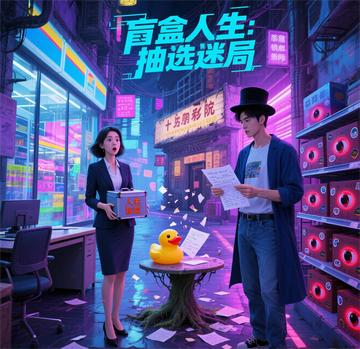
When social worker Su Nian picked up an iron box with the "Blind Box of Life" printed on it at a convenience store, the first "Workplace Koi Card" she pulled out actually allowed her to be promoted to director in seconds, at the cost of a rubber duck growing out of her desk that could chew documents. Jiang Chen, a programmer who rented the same room, secretly opened the second blind box. The "lucky charm of love" made him suddenly switch to the accent of a young master from the Republic of China during a date. The newspaper from 1999 that fell out of the blind box had a headline that read "Blind box experimenters have disappeared collectively." What's even weirder is that the city street scene will randomly change after each box is drawn - the cafe that was there just now turns into a 1980s video hall, and the blind boxes on the shelves stare at them with sticker eyes. Su Nian found laser engravings on the bottom of the box: "What you drew is a life script that someone else has replaced." When Jiang Chen used the code to analyze the frequency of the blind box, he discovered that their life trajectories were being uploaded to an unknown server - this blind box game that exchanged reality for surprises was nothing more than a card drawing pool used by higher-dimensional creatures to harvest life experiences.