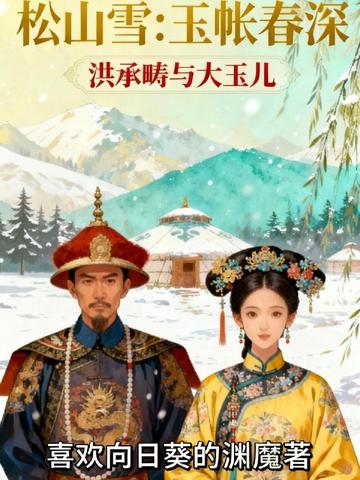
He is a history teacher on the modern podium, but he once transformed into the controversial "Second Minister" Hong Chengchou in the early Qing Dynasty - when he opened his eyes, he saw the tenderness and fullness of the Northeastern Jade Sister - Da Yu'er.
On one side was Huang Taiji's suspicion, on the other side was Shi Bi's contempt. Even he himself believed that this body was destined to bear infamy.
Until he met the roll of coarse cloth dyed with the scent of cotton wool.
In the work shed in Shengjing, Han and Mongolian women cried while clutching twisted balls of thread, and Jiangnan weavers shook their heads and sighed, "Skillful skills cannot teach stupid skills";
He squatted beside the spinning wheel to modify parts, his fingertips were blistered, but Da Yu'er stood in the shadow holding a thousand layers of bottom: "I want to understand what you are doing."
So there was cloth dyed blue, fingers to strangle bleeding beads, and sheep carts that herdsmen squeezed their heads to pieces——
When the word "profit" popped up for the first time in the textile bureau's ledger, he gritted his teeth and gave out 30% of the profit: "The herdsmen who sell wool should get the benefit."
Horqin's old man knelt down and put fried rice into his hand: "After living for seventy years, this is the first time that silver is more valuable than lamb."
Dayu'er smiled and wiped the rice grains from the corner of his mouth: "You are not a Bodhisattva, you are a person who wants everyone to be well."
From "Second Minister" to "Redeemer", he went from being a stain in the history books to becoming a bridge between the grassland and the Central Plains——
Hidden in the hum of the loom is his unspoken ambition:
What he wants to wash away is not his own infamy, but the failure of "people's hearts" in this era.
When Dayu'er handed over the cloth dyed with prairie blue, and when the herdsmen's sheep carts ran over the morning dew in Shengjing, he finally understood:
The so-called "rebirth" is never the forgiveness of Shibi.
It's the smile of Han and Mongolian women, it's wool