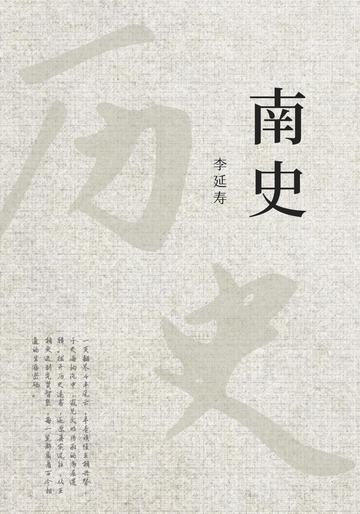
"Southern History" is a masterpiece of chronicle and chronological history written by Tang Dynasty historian Li Yanshou. The book has a total of eighty volumes, including ten volumes of chronicle and seventy volumes of biographies. It records the rise and fall of the four political regimes of Song, Qi, Liang and Chen in the Southern Dynasties during more than a hundred years from the first year of Yongchu in Liu Song Dynasty (420) to the third year of Zhenming in Nanchen (589).
The book not only sorts out the replacement of emperors and the rise and fall of dynasties, but also shows the colorful lives of royal families, nobles, civil servants and generals, relatives of wealthy families, and famous families through biographies. You can read about legends about pioneer generals, concubines in the palace, children of aristocratic families, and wise men in the countryside: there are military generals who spent their lives in the army in troubled times, and there are also kings and nobles who are trapped in the power struggle in the palace; there are emperors who try to turn the tide, and there are ordinary people who are swept away by the torrent of the times. Moreover, the strife in the officialdom, the decline of the gentry, and social changes gradually unfolded in the text.
When Li Yanshou compiled this book, he advocated "cutting out the complex and simplifying it", using the "Song Book", "Nan Qi Book", "Liang Book", "Chen Book", etc. As the bases, eliminating the redundancy and extracting the essence to form a unified and clear-structured history of the Southern Dynasties. Therefore, "Southern History" can not only be used as historical materials, but also has strong readability.
If you want to explore the rise and fall of political power in southern China during the Southern and Northern Dynasties, the ups and downs of power of powerful families, and the joys and sorrows of individuals in the historical torrent, then "Southern History" will take you through troubled times and see how the times shape characters, and how characters reflect the times.