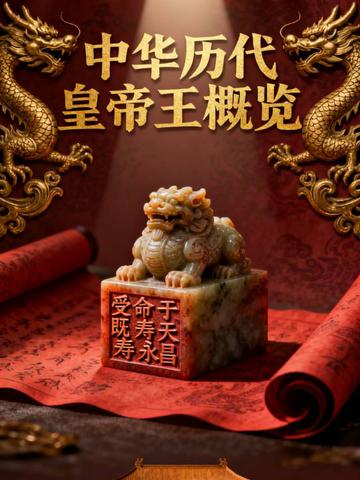
Chinese emperors of all dynasties are the core promoters of the historical process. Xia Qi opened up the world, and King Tang of Shang and King Wu of Zhou laid the foundation of the early dynasty. The Qin and Han Dynasties were unified, with Emperor Qin Shi Huang establishing the imperial system and Emperor Wu of the Han Dynasty expanding the territory. Although the Wei, Jin, Southern and Northern Dynasties were divided, Emperor Xiaowen's reforms promoted integration. During the prosperous years of the Sui and Tang Dynasties, Emperor Wen of the Sui Dynasty established the imperial examination, Emperor Taizong of the Tang Dynasty established the Zhenguan rule, and Wu Zetian broke the shackles of gender. The Song Dynasty, Yuan Dynasty, Ming Dynasty and Qing Dynasty each had their own glorious chapters. The Song Taizu concentrated power, the Yuan Shizu expanded the territory, the Ming Taizu deposed the prime minister, and the Kangxi Emperor established the territory. They created institutions, expanded territory, or promoted culture and governance. They were both founders of great talents and strategists, as well as wise kings who maintained their rule. Their merits and demerits were intertwined into the development of Chinese civilization, and they witnessed the changes of dynasties and the changes of the times.