The two red lines on my wife's pregnancy test stick made me ecstatic.
But three days ago, I just found her infertility diagnosis certificate in the deepest part of her drawer.
I suppressed my shock, pretended to be happy, and began to investigate secretly.
When I finally proved that the child was mine after all the hardships, she handed me a divorce agreement.
"Wen Wu," she burst into tears, "you found out whose child it is, but you never asked why I lied."
Reader comments
"Pregnancy Lie" tears away the most respectable cloak of urban marriage. The simultaneous appearance of the pregnancy test stick and the infertility diagnosis is not only a perfect start to the suspense, but also a cruel portrayal of the collapse of trust. Every investigation by Wen Wu and every lie by Qu Xiaoxiao are as precise as a scalpel to cut open the chronic disease in modern intimate relationships: deep love without communication is more destructive than betrayal. This is not only a murder story about "whose child is", but also a soul torture about love, trust and self-salvation.
The fast pace of online writing is fully reflected in this work.
From the climactic suspense setting at the beginning to the irresistible "magic hook" at the end of each chapter, the author accurately grasps the reader's psychology.
The inner monologue from Wen Wu's perspective is very immersive, allowing readers to jump repeatedly in the emotional whirlpool of "feeling sorry for the female protagonist - understanding the male protagonist - doubting everyone".
Under the fast-paced narrative, the information density is extremely high, and there are almost no wasted pens. It can be called a model for mobile reading.
This novel cleverly weaves real-life issues such as "fertility pressure", "workplace involution" and "conflict of intergenerational concepts" into a suspenseful context.
Wen Wu's 996 and anxiety about inheriting the family line, and Qu Xiaoxiao's struggle between family and self-worth are all dilemmas that urbanites are experiencing today. While the story solves the mystery, it also guides us to think: Under the pressure of life, are we still capable of seeing clearly the isolated island called "love" in each other's hearts?
Just when you thought uncovering "artificial insemination" was the answer to the mystery, clues about "American frozen semen" surfaced; when you confirmed the child's bloodline, the notes in the DNA report planted a depth bomb.
The author's layout ability is first-rate, and the threads of grass and snakes lie thousands of miles apart. What's even more rare is that all reversals serve the purpose of characterization and theme expression, rather than suspense for the sake of suspense. The ultimate "redefinition of home" breaks the conventions of traditional narratives and brings shock and thought.
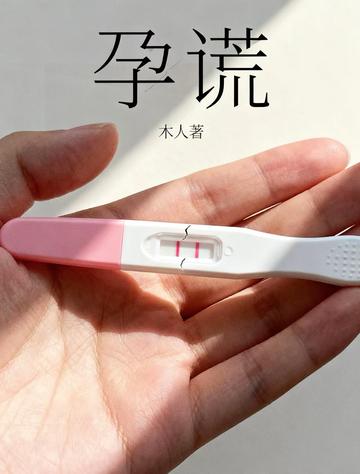
"Pregnancy Lie" tears away the most respectable cloak of urban marriage. The simultaneous appearance of the pregnancy test stick and the infertility diagnosis is not only a perfect start to the suspense, but also a cruel portrayal of the collapse of trust. Every investigation by Wen Wu and every lie by Qu Xiaoxiao are as precise as a scalpel to cut open the chronic disease in modern intimate relationships: deep love without communication is more destructive than betrayal. This is not only a murder story about "whose child is", but also a soul torture about love, trust and self-salvation.
The fast pace of online writing is fully reflected in this work. From the climactic suspense setting at the beginning to the irresistible "magic hook" at the end of each chapter, the author accurately grasps the reader's psychology. The inner monologue from Wen Wu's perspective is very immersive, allowing readers to jump repeatedly in the emotional whirlpool of "feeling sorry for the female protagonist - understanding the male protagonist - doubting everyone". Under the fast-paced narrative, the information density is extremely high, and there are almost no wasted pens. It can be called a model for mobile reading.
This novel cleverly weaves real-life issues such as "fertility pressure", "workplace involution" and "conflict of intergenerational concepts" into a suspenseful context. Wen Wu's 996 and anxiety about inheriting the family line, and Qu Xiaoxiao's struggle between family and self-worth are all dilemmas that urbanites are experiencing today. While the story solves the mystery, it also guides us to think: Under the pressure of life, are we still capable of seeing clearly the isolated island called "love" in each other's hearts?
Just when you thought uncovering "artificial insemination" was the answer to the mystery, clues about "American frozen semen" surfaced; when you confirmed the child's bloodline, the notes in the DNA report planted a depth bomb. The author's layout ability is first-rate, and the threads of grass and snakes lie thousands of miles apart. What's even more rare is that all reversals serve the purpose of characterization and theme expression, rather than suspense for the sake of suspense. The ultimate "redefinition of home" breaks the conventions of traditional narratives and brings shock and thought.