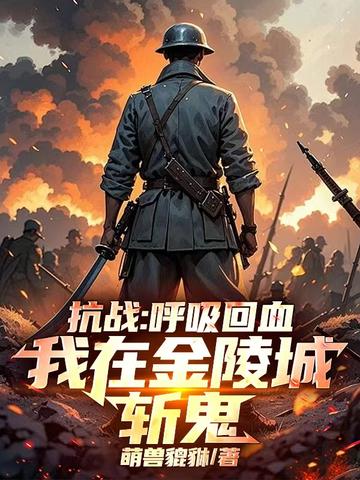
Anti-Japanese War: Breathing Back Blood, I Kill Ghosts in Jinling City
抗战:呼吸回血,我在金陵城斩鬼
- Status
- Ongoing
- Length
- 207k Words
- Genre
- Urban
- Subgenre
- War & Espionage
- Audience
- Male
- Updated
- 8mo ago
- Source
- Fanqie
Stats
53Reads
6.1Score
101Chapters
7Listens
67.9kReads · all time

The jujube tree in the courtyard somehow produced a few fruits this year. When I picked them and tasted them, they were a bit bitter and not good. But when I think of you in my dream, the sourness in my mouth becomes a little sweeter. In my spare time, I turned to look out the window. There is summer, but it is not just summer. There is chaos, there is idleness, and there is splendor and splendor that cannot be concealed by spring flowers and autumn moon. There are green locust trees and tall willows swallowing new cicadas, and the wind blows into the strings. There is gauze kitchen rattan mat. The room was quite stuffy, and suddenly I felt inspired, so I picked up the pen that had not been wet for a long time. I felt that I should write something, but I didn't know where to start. Maybe it was because I was feeling depressed that day, so I wrote down the next "front row" and then gave it up.
The five-star praise is because the protagonist stayed in Nanjing. Without witnessing the tragedies with his own eyes, based on the overall historical situation, rational thinking of the follow-up war of resistance and the idea of leaving green hills without fear of running out of firewood, leaving Nanjing is the best solution. But when the city fell, I saw an old man being killed with my own eyes, I saw the arrogance of little devils when children and even babies were picked up by bayonets, I saw and heard the cries and despair of female compatriots being dragged away and bullied. These scenes would destroy rationality, leaving behind a solution that may not be the best, but is worthy of my conscience. If you were defeated and left voluntarily after witnessing all this, as long as you still have the bottom line of conscience, even if you live to win the Anti-Japanese War, even if you later become famous, you will never be able to get rid of the images on the streets of Nanjing: the baby on the bayonet, the crying woman, the fallen figure of his compatriots, and the pair of eyes looking at him in despair when he turned around to leave, which made it difficult to feel at ease. From a personal point of view, for those who witnessed the Nanjing tragedy, even if they stayed and saved the people who died in the end, they could not change history. I think at least the people who stayed would never regret it, because they gave this compatriot the dignity of being saved and the peace of mind that he did not give up. This may be a thousand times heavier for some people than a lifetime of rational living. Not to save lives, but to prevent our compatriots from dying in such despair. Even if it's just carrying a frightened child into the cellar, even if it's just giving a sip of water to an injured old man, even if it's just blocking a compatriot with his body for a second when the Japanese army rushes over - in this second, the child knows that someone is protecting me, the old man knows that someone has not given up on me, and he himself knows that I am not watching. Even if the child was discovered in the end, even if the old man still didn't survive, he still did what a Chinese should do: when his compatriots were at their most desperate, he gave them a touch of warmth and gave the Japanese army a shot of resistance - even if the resistance was as small as a speck of dust, it was more like a human being than the rationality of turning around and running away. Not to change history, but to keep one's own conscience. For those left behind, what is saved is never a person who can survive, but the dignity of a Chinese person and the tone in his heart. Even if he died in the end, he left with the magnanimity that I had fought for and saved; instead of living a lifetime of nightmares like those who run away, with the guilt of "I saw it, I was scared, and I ran away" and the rational thinking of "I will kill more invaders for the sake of the overall situation." Of course, these are based on the premise of witnessing the Nanjing tragedy, witnessing these human tragedies, and knowing that no less than 300,000 people will experience these tragedies and despair.
Overall, not bad It's just that the protagonist is a weapons student, so he seems a bit not very smart.
The section "Little Boy" in Chapter 4 contains creatures that are difficult to comment on. Remember not to click on comments, you will be shocked [smile]
Very good, much better than those systems that are invincible and explosive from the start
If you don't have a gun, why keep using a knife? The protagonist doesn't think he is immortal, does he?
The protagonist is Said
It's okay, but there's a little space. ? ? ? ? ? ? ? What the hell, what is the girl in that chapter? As long as it is normal, how can a girl run past the Japanese soldiers...
It's okay, it's pretty good-looking
It's okay. Occasionally, some high blood pressure operations will make people emotional, but it shouldn't be too much.
A very good time-travel anti-Japanese novel
I don't remember there being a photo studio [thinking]
Author, come on, it's not enough. Can ten chapters a day be okay? Twenty chapters that I don't pick are also okay [shy]
Don't be too real [crying]
A very good anti-Japanese novel.
Well written, don't let it suck.
Are there any similar mindless and cool articles?
Good, good, good, good, good, good, good, good
A good-looking and well-written anti-Japanese novel.
I am the author, thank you all for reading.