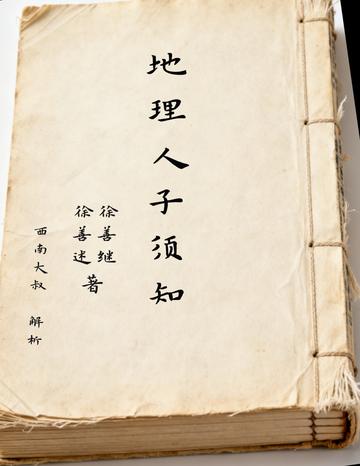
The Essentials of Geography and Human Destiny is a classic Ming dynasty work on feng shui from the Form School, written by the twin brothers Xu Shanji and Xu Shanshu of Dexing, Jiangxi. After their father died, the two brothers abandoned their studies for the imperial examinations and spent thirty years surveying mountains, rivers, and burial sites across more than ten provinces, including Yan and Qi. They wrote the book with the principle of “serving filial devotion and bringing peace to one’s parents” at its heart.
The book centers on five key elements: dragon, cave, sand, water, and orientation. It emphasizes that “a dragon is valued for its changing formations,” “sand and water should complement each other,” and “a cave should harness vital energy.” It favors on-site investigation and evidence, criticizing abstract, fanciful theories such as the “Eight Mansions trigram method.” The book includes more than a hundred landscape illustrations and real-world examples, including the ancestral grounds of Wang Daokun in Wuyuan and of Minister Dai in Fuliang.
Hailed as “the encyclopedia of Ming dynasty feng shui,” the book builds on Yang Yunsong’s The Dragon-Shaking Classic and paved the way for the Qing dynasty’s Complete Book of Mountain Methods, establishing the principle that “landform comes first, while the circulation of qi serves as a tool.” From a modern perspective, its idea of “sheltering from the wind and gathering water” aligns with ecological planning, and offers a useful reference for protecting cultural heritage such as the Ming Tombs. It combines Confucian ethical concern with an empirical spirit.