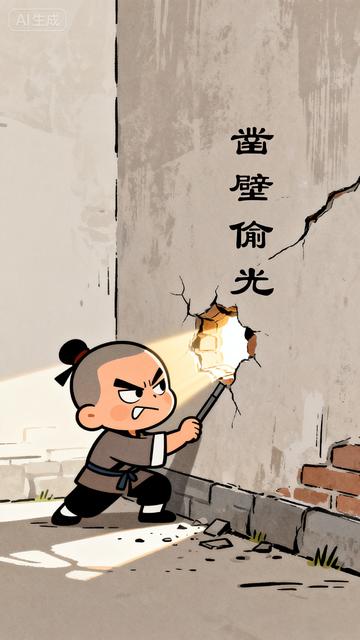
Do you think that cutting through walls and stealing light is an inspirational myth about poor families studying hard?
Wrong! Behind this is the power calculation of the Western Han gentry, and the blood and tears of an honest man!
Wu Laoer couldn't figure it out: He obviously offered to lend an oil lamp to Kuang Heng next door to study, but this guy turned around and dug into the wall to "steal the light"!
What's even more annoying is that when the barnyard official came, he became the "evil neighbor" who forced Kuang's father to kneel down, while Kuang Heng became an inspirational young man praised by everyone.
People in the streets scolded him for being stingy, but Li Zheng advised him to "don't care about celebrities."
Even the holes in the wall were dug and blocked, blocked and dug again, for people to visit the "stealing scene".
But no one knew that Kuang Heng was not the child who cried over the two reed chickens.
He has seen Taifu Xiao's guard of honor and heard Zhu Maichen's hype of "singing at a low salary".
The great man who had a monopoly on official career among the gentry knew better that "fame" was the ladder to heaven for the common people.
Cutting walls, borrowing money, and selling things at a miserable price are all his step-by-step drama.
Here Xiao Wangzhi used Kuang Heng to please the emperor, and over there Liu Xun used "common people's talents" to defeat the nobles, and even Prime Minister Wei Xian was making plans in the dark.
Everyone is benefiting from this "selection of talents" drama. Only Wu Laoer squatted in the corner to mend holes, and his hair fell out.
When the plaque conferring "a model of diligent study by the common people" is hung in Kuang's house, who will take care of Wu Laoer's grievances?
And can Kuang Heng, who has risen to the top through drama, really be able to stay on his path to success?