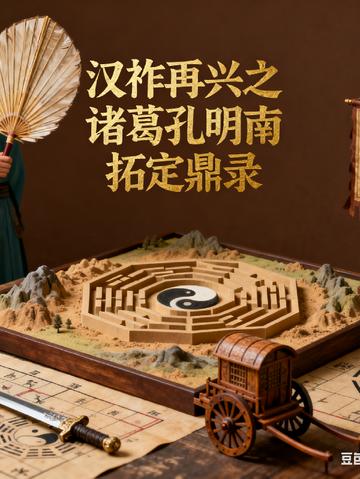
Jieting was defeated, and the foundation of Shu Han's Northern Expedition was shaken. The grain depot was empty and Yizhou was exhausted. Zhuge Liang spent the whole night reviewing his plans in the Hanzhong camp, and finally broke his obsession with "expedition only to the north to restore the Han Dynasty" - if sticking to the northern route would be to hit the stone with an egg, it would be better to turn to the southwest, use the Indochina Peninsula as the foundation, and take the reverse path of "expanding to the south to build the foundation, first Wu and then Wei".
He overcame all opinions and persuaded Wei Yan to implement the "unity of farming and warfare" in Hanzhong, united with Meng Huo to integrate the Vietnamese soldiers in South China, instigated Aji, the leader of Myanmar's Shan State, to form a coalition army, and even used tribal conflicts to "support war with war": the first expedition to Shan State won elephant soldiers and 100,000 stones. For grain, they conquered northern Thailand and Laos to open up rice granaries, conquered southern Vietnam to open up the South China Sea trade route, and even crossed the Naga Mountains to connect with the Naga people in India. They built spice bases and cavalry camps to completely make up for the two major shortcomings of the Shu Han's food shortage and cavalry.
After that, he used the strategy of "alliance with Wei to paralyze Soochow", divided the north and south to sweep across the east of the Yangtze River, and incorporated the Soochow Navy; he also led a multi-ethnic coalition to attack Wei in three ways, defeated Sima Yi's main force in a decisive battle in Chang'an, broke down the resistance of the Cao Wei gentry, and finally helped Liu Chan restore Han Zuo and rule the world.
This work, which combines the historical materials and fictional ideas of "Three Kingdoms" and "Huayang Kingdom", with Zhuge Liang as the soul, writes a history of reverse reform that "did not follow the old path and faced dangers": from a corner of the southwest to the New Han Dynasty, whose territory spanned the East China Sea to the Western Regions, the South China Sea to the Great Wall, and witnessed a generation of wise ministers using strategic wisdom to reverse the fate of the Shu Han Dynasty and create a prosperous age of multi-ethnic integration.