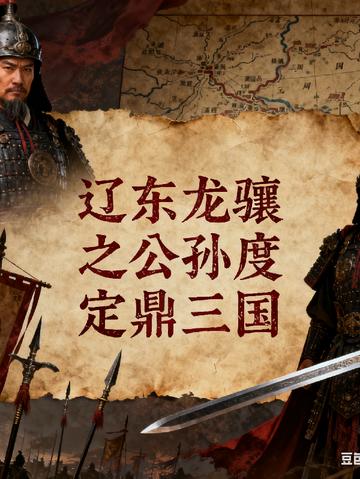
At the end of the Eastern Han Dynasty, the Yellow Turbans swept across the country, Dong Zhuo revolted in Beijing, and the Central Plains fell into a quagmire of war between feudal princes. Cao Cao held the emperor hostage to order the princes, Yuan Shao occupied Hebei and supported strong troops, Liu Bei still had ambitions to prosper the Han Dynasty under the fence, and Sun Quan inherited his father's and brother's inheritance and ruled Jiangdong. While all the eyes of the world were focused on the competition in the Central Plains, an "extraordinary figure" quietly emerged in Liaodong County (today's eastern Liaoning Province): the new governor of Liaodong, Gongsun Du, started with a weak start when he arrived on a bicycle. He frightened the powerful with a cold blade, solidified the foundation with a field camp, and planted the seeds of overturning the Three Kingdoms pattern in the frozen soil and grasslands of Northeast Asia.
He was well versed in the way of survival of "not being the first bird". He first joined forces with Gongsun Zan as a barrier to keep Yuan Shao out of Youzhou; then he marched northward, destroyed Yilou, captured Xianbei, surrendered Wuhuan, and incorporated Monan and Mobei into his territory, creating an iron-blooded fighting force of 50,000 "Monan Iron Cavalry"; when the war in Guandu broke out, he again With the power of lightning, he captured and merged states, swallowed up Jizhou, and destroyed Yanzhou, defeating the remnants of Yuan Cao in one fell swoop and unifying the north. Finally, he used the power of the north to march south, captured Jingzhou without a fight, traced the river to level Yizhou, destroyed Jiangdong by land and water, and even expanded the western regions and opened overseas, re-melting the divided world under the banner of "Liao".
This is not the traditional Three Kingdoms of Cao Liusun, but the "history of fighting for hegemony against the odds" belonging to Gongsundu - from a local governor in a corner of Liaodong to the founding emperor who ended the troubled times. He used the strategic wisdom of "expanding north to gather strength, taking advantage of chaos, and using the strong to defeat the weak". In the wars of the late Han Dynasty, he blazed a completely different path to unification, and for the first time the grasslands, frozen soil of Northeast Asia, and the fertile fields and rivers of the Central Plains were truly integrated into a powerful unified dynasty.