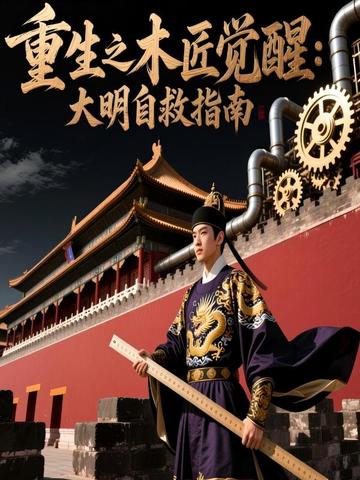
Rebirth of the Carpenter: a Guide to Self-Rescue in the Ming Dynasty
重生之木匠觉醒:大明自救指南
- Status
- Ongoing
- Length
- 594k Words
- Genre
- Historical
- Subgenre
- Historical High-Concept
- Audience
- Male
- Updated
- 3mo ago
- Source
- Fanqie
Stats
Tags
Synopsis
Reader comments
In booklists 5


The Glory of the Ming Dynasty, Please Be Yongle
I only want it from the Yongle period, please.
People Across the Country Watched a Live Broadcast of Tomb Robbery Notes and What Everyone Experienced
1. The little brother lost his memory and came to the show crew to participate in the show and was exposed by the show crew. 2. The innocent, fat, little flower and blind people are all there‼ ️3. Focus on these five people and don't cross
Give Me Some of the Pinnacle Books of the Ming Dynasty





Succubus, Chasing Husband Crematorium
Want to watch something like "Only making money and not dating, I am the best professional dog licker!" (Around the Lone Star)" book.
I Want Books to Revitalize the Ming Dynasty, Not Western Pseudo-History, but Real and Well-Written Books.
I want to read a book similar to "The Ming Dynasty: I asked you to hang yourself, but not to rebuild the Ming Dynasty". Ming Dynasty History In addition, you can also read the book I posted. It is really well written. The author restores the true history while continuing to write the story of the Ming Dynasty. It is a pity that in order to write
The protagonist Chen is far less like a savior and more like a "maintenance engineer" holding a historical blueprint and future tools. He regards the collapsed Ming Dynasty as a malfunctioning precision instrument, using a carving knife instead of a wrench, using technology as consumables, and repairing its decayed parts one by one, which is both hard-core and romantic.
What the protagonist established in a corner of the Forbidden City was more than just a small workshop, it was clearly a 17th-century "cyberpunk" incubator. When precision gear structures meet future energy, and when programming thinking is mixed into eight-legged articles, this sense of dislocation intertwined between ancient and modern times constitutes the unique charm of this book.
Chen Yuan used modern project management thinking to break down the grand plan of salvation into executable carpentry orders, and quietly changed the world while hammering and planing. This "practical sense" makes the science fiction setting come true and is particularly credible.
Opening this book, one seems to see the amazing linkage between "Tiangong Kaiwu" and "The Three-Body Problem". The author uses his solid historical foundation as the soil to plant an imaginative science fiction tree. Every "technical leak" of the protagonist is like dropping a stone in the long river of time, and the ripple effect makes the plot full of tension.
This is not a simple story about the Ming Dynasty's strengthening of the country, but a civilization's self-rescue that starts with a plane and ends with a starship. The protagonist did not rely on advanced black technology, but made a "rational leap" based on the conditions at the time. Each step of the upgrade was solid and credible, providing a new writing template for historical science fiction novels.
The body of the carpenter emperor Zhu Youxiao contains the soul of modern engineer Chen Yuan. See how he hides future technology between mortises and tenons, uses nano-coatings to strengthen his armor, and uses energy cores to drive machine tools. This is not only the awakening of carpenters, but also a leap in civilization levels. The combination of hard-core research and bold imagination is amazing.
Others were busy fighting in the palace when they were reborn as emperors, but Chen Yuan was reborn as Zhu Youxiao and became the strongest "puppet master" in history. It's just that he controls the entire Ming Dynasty's industrial system. The wooden kite became a reconnaissance drone, and the wooden cow and flowing horse transformed into a transport convoy. This setting, which perfectly embeds science fiction elements into the historical background, is both reasonable and subversive.
The most touching twist in this book is that the "craftsmanship" that was despised by scholar-bureaucrats in history has become the only fire for the survival of civilization. Watch how the protagonist gradually builds the woodworking room into a center of power more important than the cabinet and vindicates the "craftsman spirit". The process is full of dramatic tension and ideological depth.
The author uses a dual-line narrative to not only describe the end-of-life glitz of the Ming Dynasty, but also depict the blooming of the hidden technological tree. The layout is grand and the details are full, bringing an immersive reading experience.