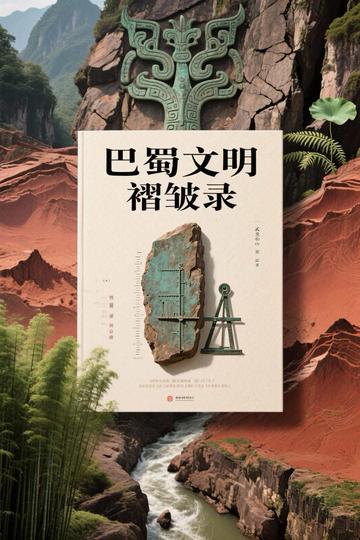
When my fingertips probe a crevice in the Longmenshan Fault Zone, the patterns in Jurassic sandstone turn out to fit perfectly with the designs on the Sanxingdui Bronze Sacred Tree. This accidental touch reveals the central premise of this book: the earth itself is a cipher for civilization. This epic exploration bears witness to the sacrificial secrets of the ancient Shu Kingdom hidden in the fault ruptured by the Wenchuan earthquake, the Warring States-era carvings in the Dujiangyan sandstone core that are actually fluid mechanics formulas, and the ecological accounting revealed by comparing carbon sequestration data from the Shunan Bamboo Sea with grain consumption records in the Records of Huayang. The book's original "Triangular Prism Narrative" brings geological data, historical documents, and contemporary insights into a remarkable optical interplay. In the Great Rift Valley of the Wuling Mountains, the mountain-building movement of 600 million years ago resonates with the ecological philosophy in Wang Anshi's Treatise on Materials. Amid the sounds of chisels striking the Ming and Qing plank roads, one can hear the ancient echoes of the Indian Plate's collision. This cross-disciplinary narrative reveals a paradigm-shifting discovery: every major leap in human civilization has been a creative response to geological memory. The most powerful exchange takes place in the chapter "Blood and Neon." As the glass curtain walls of Tianfu New Area reflect the snowy peaks of Longmenshan, the mineral crystals in modern buildings resonate optically with quartz veins in ancient rock strata. It is much like people today using digital technology to reenact the survival wisdom of "carving plank roads into sheer cliffs." Open this book, and you will hear how the ticking of Li Bing's leveling instrument harmonizes with satellite remote sensing data, and how pollen maps of the ancient Cancong people's migration south foretold the ecological corridors of the Chengdu-Chongqing Economic Circle.
Now, please touch this book. If you feel a faint tremor, it is the unceasing pulse of the Bashu land over the past 200 million years. The human story has always been the youngest chapter in the geological epic.