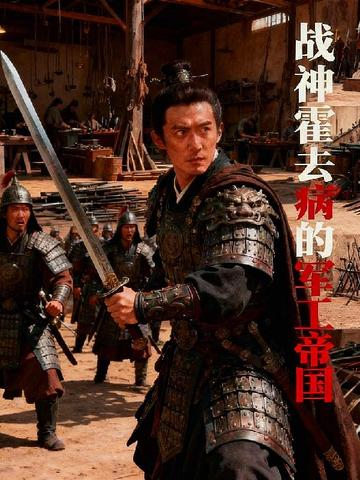
"The Military-Industrial Empire of Huo Qubing, God of War" is a historical biography focusing on the military genius Huo Qubing of the Western Han Dynasty. The work uses an epic style to outline how this young star, who rose to prominence at the age of eighteen and fell at the age of twenty-four, cut through the sky like a comet and reshaped the Asian landscape. This book not only shows the battlefield myth of "the wolf is sealed and lives in Xu", but also provides an in-depth analysis of the scientific and technological cornerstones, military-industrial map and confidence of the times behind its glorious achievements.
The iron smelting technology of the Han Dynasty contributed to the sharpness of the Han army: the ring-shou sword forged by hundreds of steel refineries, and the powerful crossbow with a range of 400 steps, forming a generational advantage over the Xiongnu. Standardized production of arrow clusters ensures logistics, and precise surveying and mapping technology and Sinan positioning enable the army to accurately penetrate the desert. Qin Zhidao, Fengsui System and mature horse administration veterinarians jointly supported the implementation of his lightning tactics.
The work follows the Hexi Corridor to Lake Baikal, not only seeing the aesthetics of war but also exploring the undercurrents of decision-making in the Weiyang Palace and the diplomatic network of the Han Empire. There is a unique analysis of Huo Qubing's special relationship with Emperor Wu of the Han Dynasty, his complementary tactics with Wei Qing, and even the profound impact of his early death on the war situation. This is not only the legend of a genius general, but also a majestic picture of the heyday of Emperor Wu of the Han Dynasty, showing the pinnacle achievements of Chinese civilization in military technology, national mobilization and pioneering spirit.