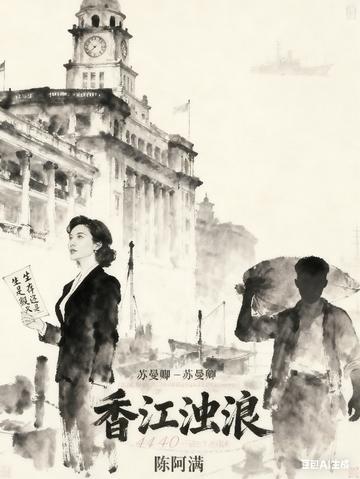
Hong Kong in 1941 was a floating city under the colonial lights - Chen Aman, a refugee from Chaoshan, carried a bag of rice to survive in the alleys of Central. The carpenter plane hidden under the bed was his only memory of his homeland; Su Manqing, the daughter of a Chinese school teacher, walked through the Hong Kong University campus carrying English textbooks, but there was an anti-Japanese leaflet printed by her father hidden at the bottom of her schoolbag. A dock strike caused the two to collide unexpectedly. He fended off the colonial police for her, but she mistakenly regarded him as a "helper of the capitalists." Their fate in troubled times began with misunderstanding and temptation.
The sirens of Japanese air raids tore apart the bustling city, and Aman lost the "money" he had saved for three years to marry his mother in the chaos. Manqing's father fell under the gunpoint of the Japanese army, and before his death, he stuffed the blood-stained anti-Japanese list into her hairpin. From then on, the attic of the tenement building became a secret stronghold. Grandma Zhou used the coal stove of the fish egg stall to hide the list and pretended to be crazy to deceive the Japanese army.
The bell of liberation rang in 1945, but Hong Kong did not usher in true peace. The colonial police closed down Aman's carpentry shop, saying that "Chinese people are not worthy of a license"; Manqing opened a night class in the carpentry shop to teach Chinese and was regarded as a "radical". But the lights in the tenement building are always on - Chen Yao changed his gang into a freight company to help Aman transport wood; Dr. Zhao from the mainland opened a free clinic in the alley to treat refugees; A Ming, the young refugee who was taken in by Aman, took a Chinese Manchurian