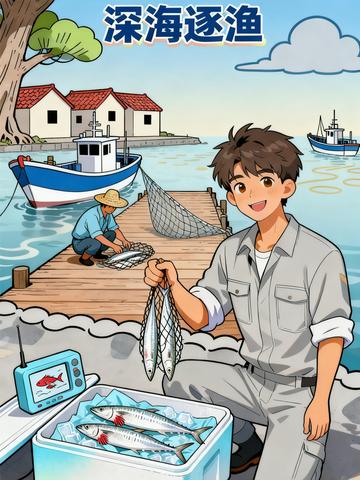
Three years ago, he left his hometown with his attachment to the sea and broke his head in a fishery company in the city; three years later, he returned with a half-used backpack. Looking at the old fishing boat that his father had repaired for ten years and the white hair on his mother's temples, he finally made up his mind: not to leave, but to make his own way in the sea that gave birth to him and raised him.
There is no halo of rebirth, no chance from heaven. All Chu Hang has is a pair of eyes that can see the waves clearly, his father's step-by-step instruction in fishing skills, and the seafood porridge that his mother always warms in the morning. He wants to renovate old fishing boats and install them with new engines and fish finders; he wants to try live-streaming fishing sales so that the tables of city residents can be filled with fresh produce caught from the sea that day; and he also wants to revive the lively sound of boat whistles in deserted fishing villages.
When the boat was being repaired, his father squatted beside the boat and taught him the strength of hammering nails, with years of experience hidden in every stroke. When preparing for the live broadcast, his mother dug out the white cloth from the bottom of the box, washed it twice and spread it on the table, saying, "It must be seen as clean." Even when he faced the camera for the first time, his father, who was not good at words, would blush and say, "Our fish are all freshly caught."
From the live broadcast at sea at five o'clock in the morning, to the packing and shipping of cold chain trucks in the afternoon; from the sporadic "expectations" in the live broadcast room, to the "two more pounds" from more and more repeat customers; from the 20 kilometers of offshore sea near the village to the deep blue sea farther away, Chu Hang, with the support of his family, gradually turned "Chu Hang's Seafood Courtyard" into a signature.