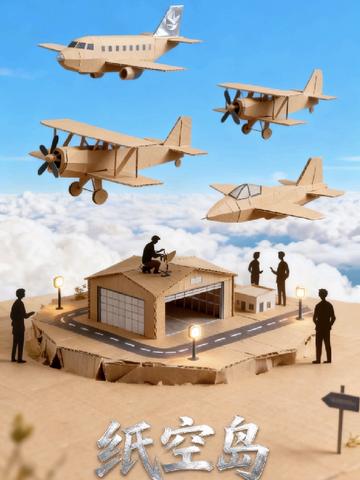
When strong winds carried pieces of cardboard across the cliff, Lin Ye and six strangers huddled in a rickety prototype, and for the first time they understood the weight of "flying" - the fuselage was made of damp cardboard, propelled by a hand-cranked paper fan, and beneath their feet was a bottomless sea of clouds and water.
This is a cardboard island, an aerial arena built with paper knives and tape. All teams are newcomers and only have one officially issued "broken prototype" in hand. There are no instructions and no way out. During the 120-day season, they must repair the wings in heavy rain, adjust the tail in turbulence, and compete for survival resources in narrow cardboard buildings.
Linye's team always talks about "it would be nice to be wider" - they want to build a plane that can allow everyone to stand, a "big guy" that can fly steadily carrying cardboard and trust; some teams are obsessed with shortening the fuselage and shuttle like hummingbirds; some are obsessed with making the cardboard rotors rotate, trying to escape the fate of gliding; others just want to be followers of the wind, letting the tail guide the direction like a weathervane.
No one knows why the empty island exists, and no one knows what will happen in the next mission. But when the tape wrapped tightly around the broken wing, when the paper fan shook out the thrust against the strong wind, when six pairs of hands grasped a cardboard control rod at the same time in the bumps - they gradually understood that it was never technology that could make the cardboard fly far away, but the tacit understanding and courage that grew in the cracks.
This is a story about how a group of people used the simplest materials to create their own route.