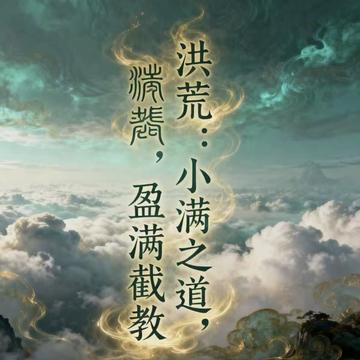
Xia Xiaoman escaped the blood and flames of the Investiture of the Gods and walked through the depths of the sea for 1,243 years. Not in some earth-shattering fashion, but one step at a time, one lamp at a time. As he walked, he rescued people, planted crops, and wrote books. He gathered together those sparks that were about to go out and protected them until they could burn again.
The day he walked back to Golden Turtle Island, he didn't cry. He simply stood beneath the flagpole, gazing at the flag that had been raised once more.
Then he set off again.
He sailed beyond the chaos in a small boat. Before leaving, he wrote just three lines: "I'm going to find more fertile soil for 'Xiaoman.' Don't look for me. You are 'Xiaoman.'"
This book isn't about domination or becoming a saint, not even about "non-contention." It is about something simpler: living, living well, and helping others live well, too. Then moving forward, as far as you can go.
The most moving moments in this book aren't battles. They're the pot of porridge that keeps "accidentally" getting knocked over beneath Five Elements Mountain, the innkeepers along the Journey to the West who never say much, and the figure on the reef gazing out at the sea for more than a thousand years.
It makes us believe that some paths, walked long enough, become the Dao.



Smiled. Ancient times. Even the lowest-ranking servant of Heaven. He won't wash his clothes until they turn white. You said there is no high-quality Lingbao armor, so let's not talk about it. A piece of clothing can be washed until it turns white. 6
The ancient monks only knew how to take, but did not know how to give back. Isn't this calamity created by the prehistoric monks themselves? Isn't the purpose of the Conferred God List just to restrain them? If there is no prehistoric world, how can one practice cultivation?
A bit bored, go to work in the wilderness? It's okay to just leave it to urban culture. It's necessary to go to the great wilderness!
If I count according to the traditional definition of Jiejiao, I have actually deviated from it, from going against nature to following the order of heaven, finding ways to survive, and deviating from the resolute style of the past. But as an expansion of the definition of Jiejiao, it is still very good in general, but I hope the author can clearly understand his definition of Jiejiao.
Fortunately, it allowed me to understand different prehistoric times from another angle, but why is it different from what you said in your introduction? It is a cool article in your introduction! But it makes me so awkward in the text. You misunderstood me, author😢😢😢😢😢
The author's writing is good, like a document within the system. The protagonist has been using various reform methods to change Jiejiao, but he has not received any reward opportunities and he himself does not care. Every time others praise him, he is satisfied... He himself does not practice to enhance his own strength, but has always devoted himself wholeheartedly without asking for anything in return. It is very institutional.
The writing is really not good! It's not like prehistoric literature! Abandoned!
It has its own different core and is worth a look.
Don't strive for hegemony, don't become a saint, don't ask for the coming of thousands of immortals. Xia Xiaoman spent more than a thousand years doing only one thing: to let more people live and live better. From the lonely lantern in the deep sea to the re-establishment of Jin'ao Island, from delivering water and repairing props on the journey to the west to opening up territories beyond the chaos - there is no grandeur, just one step at a time. Three lines before leaving: "I'm going to find more fertile ground for 'Xiao Man'. There's no need to look for me. You are 'Xiao Man'."
The writing is incomprehensible. If you love writing about the workplace, why not just write urban writing? 😆😆😆