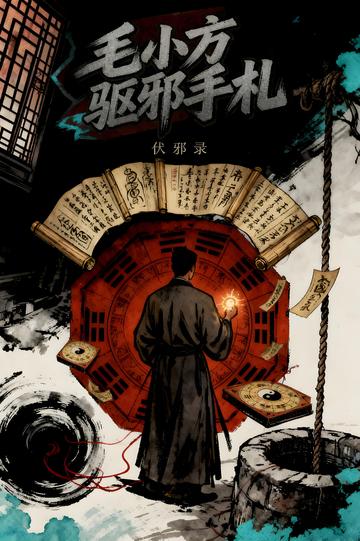
This work focuses on the legendary Maoshan Taoist priest Mao Xiaofang. It is a "hard-core" metaphysical knowledge investigation collection set in the Republic of China.
Mao Xiaofang is not a magic stick, but a scholar-type Taoist priest who is well versed in ancient classics. What he deals with is not strange stories, but bizarre cases: strange noises in ancient houses, calls for lives in dry wells, desolate mountains that confuse people, painted skins lurking, corpses causing trouble... These cases have become the key to exploring ancient metaphysical knowledge.
The core lies in "solving the case and telling the mystery":
Case-driven: Each chapter has one case, and the strange events are just the introduction.
Knowledge-based: The key point is that Mao Xiaofang uses investigation and reasoning to analyze the feng shui principles (such as evil spirits in the hall, trapped water situation), characteristics of ghosts (such as water ghosts, painted skin demons), taboos of magical weapons and other systematic knowledge behind the case. The fighting process is downplayed.
Based on ancient books: All analyzes are by no means fabricated. The theories are derived from Chinese classics such as "Ten Books of Yangzhai", "Book of Burial", "Zi Buyu", "Strange Stories from a Chinese Studio", "Shan Hai Jing", "Bao Pu Zi", etc., Restoring the profound background of metaphysical culture.
Rational decryption: Mao Xiaofang uses a rigorous attitude to explore "why" (such as the Feng Shui conditions for the formation of corpses and the dual explanations of "ghosts hitting the wall"), aiming to "know what is, and more importantly, why", get rid of superstition, and understand the connection between traditional wisdom and the environment and people's hearts.
Following Yimeidao Changmao Xiaofang, readers will delve into the essence of metaphysical culture through the cases and gain a profound perspective on rational understanding of traditional folk customs.