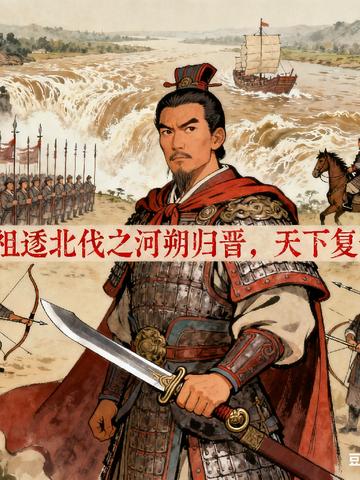
In the first year of Jianwu of the Eastern Jin Dynasty (317), the Central Plains land was sinking, the iron hoofs of Jie and Zhao crushed the clothes of the Han family, and waves of refugees migrated south. Zu Ti, who once "heard the chickens dancing" with Liu Kun, swore to "restore the Central Plains and return to his homeland" and led two thousand refugees to cross the Yangtze River north. When the middle stream struck the boat, the bronze sword chopped not only the boat's boat but also the cowardice of Pian'an Jiangzuo.
This novel is based on the "Book of Jin: Biography of Zu Ti" and "Zi Zhi Tong Jian", fictionalizing the historical branch of "Zu Ti did not die of illness", and unfolding the epic of the 14-year Northern Expedition: from the night attack on Wubao in Qiaocheng where the short spears broke through the caltrops, to the battle of Fangtou where the "Xuanqi of Jin" Mingguang armor reflected the formation of Zhaoma and Zhao; From the racket pole of the Yellow River Navy's Mengchong ship sinking the grain ship, to the sound of the crossbow shooting through the chainmail armor in the decisive battle of Xiangguo, each battle restores the shape of the weapons of the two Jin Dynasties - the broken edge of the ring-shou sword, the broken wood of the step, and the broken string of the big yellow crossbow, all hide the life-and-death contest in the cold weapon era.
The book not only contains the hard-core details of the coordination of arms (the refugee infantry forms a fish-scale formation to resist the heavy cavalry, the Xianbei light cavalry and the Jin army alternately shoot down the grain road), but also hides the choices in troubled times: the surrender and swing of the Lord of Wubao, the iron-smelting skills of the Hu craftsmen, Murong Xianbei's alliance game, and finally in Luo. At the time of offering sacrifices to heaven in Yangtai Temple, Zu Ti held the scratched Huanshou sword in his hand, and behind him were the cavalry holding horses, infantry holding rifles, and crossbowmen in formation, announcing that Heshuo returned to Jin and the world returned to Jin, so that the "Central Plains had no owner" in the early years of the Eastern Jin Dynasty finally became the grand finale of "the Han family's hometown returns to Jin".