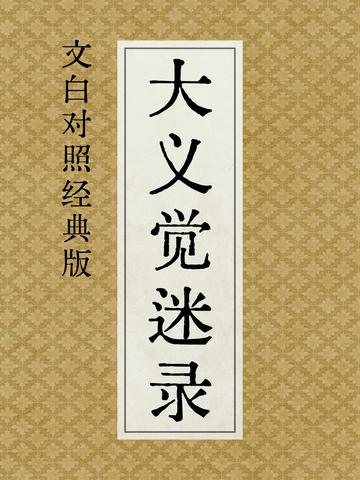
"Dayi Jue Mi Lu" classical Chinese and modern vernacular version.
This book is a national document compiled and published by Emperor Yongzheng of the Qing Dynasty. It was published in the seventh year of Yongzheng (1729) and promulgated in all prefectures and counties across the country. It is permanently archived by the Imperial Academy.
The compilation of this book originated from the Zeng Jing case in the sixth year of Yongzheng (1728). Influenced by Lu Liuliang's anti-Qing thoughts, Zeng Jing sent his disciple Zhang Xi to submit a letter to Yue Zhongqi, the governor of Sichuan and Shaanxi Province, to instigate rebellion, but failed and was later arrested. Emperor Yongzheng pardoned Zeng Jing, but severely punished the Lu family, and compiled the documents involved in the case into "Dayi Jue Mi Lu".
The book consists of four volumes. The first volume is the edict of Emperor Yongzheng, with a total of ten chapters. From then on to volume three, there are forty-seven oral confessions by Zeng Jing and two oral confessions by Zhang Xi. Zeng Jing's confession was recorded in the form of Emperor Yongzheng's questions and Zeng Jing's confession and answers. At the end of the fourth volume, there is an article from Zeng Jing's "Gui Ren Shuo", which expresses repentance and praises the orthodox status of the Qing Dynasty. Emperor Yongzheng used Confucianism as a tool to refute the long-standing Huayi concepts and Fuming thoughts, put the righteousness of monarch and ministers above the concept of Huayi, and demonstrated the rationality and legitimacy of Qing rule and its throne. Zeng Jing changed from insisting on the distinction between Huayi and opposing the Qing regime to supporting the Qing rule.
Emperor Yongzheng hoped that the book would have the effect of eliminating the national sentiments of the Han people. However, Emperor Qianlong later believed that it did not have the expected effect and instead promoted the idea of dividing Hua and Yi. Therefore, when he first ascended the throne, he banned the destruction of "Dayi Jue Mi Lu".
"Dayi Jue Mi Lu" is essentially a discussion about ideology. It combines the history of Yongzheng Emperor and the governance represented by the Qing court with the Taoism represented by Cheng and Zhu to complete the construction of a unified theory of "Huayi family". However, the book overinterprets the theories of Confucius and Mencius and lacks tolerance and flexibility. Emperor Yongzheng's self-confession also seems to be trying to cover up.