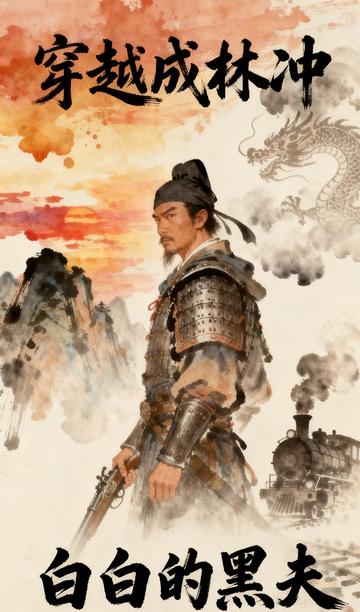
In Mengqiu, the third year of Xuanhe, in Liao'erwa, Chuzhou, when Lin Chong, the instructor of the 800,000 Imperial Army, was dying, Lin Cong, a history graduate student from the 21st century, accidentally passed through his body. At that time, Lin Chong had been deeply heartbroken by the news that Song Jiang had secretly released Gao Qiu, and he was almost poisoned by Song Jiang's cronies. Fortunately, Lu Zhishen and Wu Song rescued him in time. The miracle doctor An Daoquan also detected the highly toxic Sichuan Wu from the medicine residue, exposing Song Jiang's poisonous plan to clear the "obstacles" for recruitment.
In order to avoid the danger of death, Lin Cong (incarnate as Lin Chong) fled to Erlong Mountain with Lu Zhishen, Wu Song, and An Daoquan. With modern knowledge, he improved the curved shaft plow, built a keel waterwheel, and promoted the method of composting, doubling the grain output of the barren village; he built a firearms workshop to purify saltpeter, forged gunfire and artillery, and established an elite firearms camp; he formulated the policy of "equalizing the land and eliminating taxes" to recruit refugees, and the number of people in Erlong Mountain quickly grew from more than 300 to 30,000. He also captured Yanmen Pass, a strategic location, which shocked the Song Dynasty.
Song Jiang led the remnants of Liangshan to encircle and suppress the imperial army, but was defeated by Lin Cong using landmines and three-stage attack tactics. After that, Lin Cong's power became more and more powerful, and he proclaimed himself emperor in Youzhou, and his country was named "Daqian". Based on the Sixteenth Prefecture of Yanyun, he drove Mongolia to the Ural River in the north, crossed the Volga River in the west and conquered the Slavic tribes, defeated the South Asian coalition forces in the south, recovered Lingnan, drove away Japanese pirates in the east, and opened up the East China Sea route. During this period, scientific and technological innovations were vigorously promoted, steam engines, steam warships, radios and electric trains were built, and railway tracks were laid across Europe and Asia. Qianyuan Academy was established to popularize compulsory education, and Huimin Medical Center was built to promote epidemic prevention. The practice of "books with the same text and trains with the same track" respected the beliefs of all ethnic groups and achieved the peaceful reunification of Eurasia.