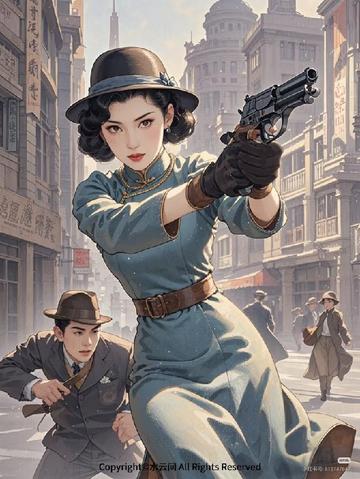
Introduction to "The Burning Cherry Code"
On New Year's Eve in 1939, Chinese businessman Rong Xuan and his wife eavesdropped on the secrets of the "Sakura Project" at a Japanese imperial banquet. However, they were silenced by the Japanese army on the return ship, leaving only half a piece of blood-stained "Spring Hope" stationery and a jade pendant with the word "Rong". In 1940, young man Gao Gao was involved in special military training. He accidentally teamed up with the mysterious woman Zhao Wei and the lurker Chen Yaxing to go to Shanghai to investigate old cases of the Rong family and the "Sakura Project". In the process, they met the noble daughter of the Rong family and a high-ranking underground party member, and uncovered the truth about the separation of the three children of the Rong family - Gao Gao was actually the last son of the Rong family, and the twin brother Morikawa was adopted by the Japanese army as a special high school teacher. Using the "Sakura Burning Plan" as the basis, everyone collaborated with the military, the Chinese Communist Party and the anti-war forces to break into Mei agencies, blow up arsenals, break the bacterial crisis, and even intercept the Japanese army's ultimate conspiracy in the Tokyo intelligence base. In the end, the Rong siblings joined forces and Morikawa turned against the enemy, smashing the "Sakura Project" in 1941, digging out the "peace of family and country" time capsule left by Rong Xuan in the old house of the Rong family, and ending the spy war with blood and wisdom.
Selling point
1. A spy war with a strong plot: 12 high-risk tasks such as the theft of secrets from the emperor's banquet, the explosion of the sea ship, and the infrared breach are intertwined. The foreshadowings such as "Jade Pendant Recognition" and "Silver Lock Communication" are throughout, with twists and turns in each episode.
2. Full of emotional tension: the separation and reunion of the Rong family children, the happy Zhao Wei's "Battlefield Love Song", Morikawa's "identity choice", the collision of family affection and faith is extremely contagious.
3. Strong historical texture: Based on Shanghai and Japan from 1939 to 1941, it incorporates the "Spring Hope" code, commercial war in the concession, and historical facts of germ warfare, with details such as cheongsam, Xingyiquan, and traditional Chinese medicine stores, etc.