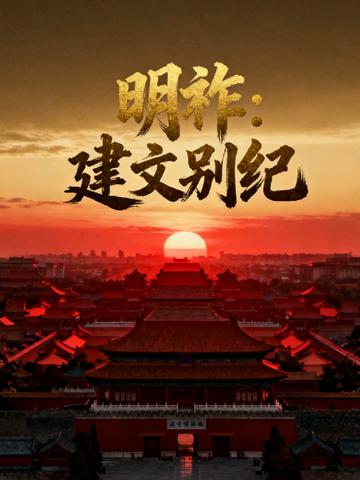
In the thirty-first year of Hongwu's reign, the candles in Nanjing's Forbidden City remained burning all night. When Zhu Yun, a graduate student in the Department of Modern History, opened his eyes, the coldness of the dragon bed and the weight of the crown told him that he had become Zhu Yunwen, the grandson of the Ming Emperor who had just ascended the throne.
According to history books, the emperor would be overthrown by his uncle Zhu Di four years later, and he would end up burning his palace and disappearing. Zhu Yun, who was well aware of the direction of history, did not choose to challenge the Yan army. Instead, when the storm of vassalization began, he secretly communicated with Peiping as the "emperor's nephew", used secret reports from the court to gain respite, and used Jiangnan grain to help Zhu Di break the siege of Peiping. He was no longer the indecisive scholar emperor, but the "behind-the-scenes driving force" hidden in the center of Nanjing - he used the bureaucracy of the Jianwen Dynasty to contain the vassal king, used the new imperial examination policy to reserve talents for Zhu Di, and even disintegrated the main force of the Southern Army with a "misjudged" transfer order in the Battle of Baigou River.
The Battle of Jingnan came to an end. In the Jinluan Palace, Zhu Di pointed his sword at the dragon chair, but Zhu Yunwen handed over the imperial seal and the "Supplement to the Hongwu Ancestor System". On the grounds of "returning to the imperial uncle to consolidate the Ming Dynasty", he resigned from the throne and was named "Prince Heshuo", with jurisdiction over Yingtian and Suzhou. He became Zhu Di's most trusted "emperor nephew" and the unique "auxiliary king" of the Ming Dynasty.
Since then, the history of the Ming Dynasty has deviated from the track: Zhu Yunwen assisted Zhu Di to rectify the officialdom, implemented the "equal land tax" which was the predecessor of "dividing every ding into an acre", and allowed water transport from the south of the Yangtze River to nourish the border towns in the north; he led the innovation of ordnance, standardized the shape of fire muskets, and established the prototype of the "Shenji Camp" to assist Zhu Di in his five expeditions to Mongolia and drink horses from the Ornan River; he personally went to the slaves
Reader comments
The writing is amazing. He sent Qiu Fu to rectify the capital camp, sent Zhu Gaoxu to resist the King of Yan, and sent Li Jinglong to guard Jinan. There has not been much fighting yet, so many people have not yet come to the scene. The King of Yan has surrendered, and it is time to name the heroes. Jiang Gui, the commander of the Jinyi Guards (died during the Taizu period), Xu Huizu was named Wei Guogong (you were still used as the title), and Qitai was the Minister of the Ministry of War (before the war, he was the Minister of the Ministry of War).
The writing is amazing. He sent Qiu Fu to rectify the capital camp, sent Zhu Gaoxu to resist the King of Yan, and sent Li Jinglong to guard Jinan. There has not been much fighting yet, so many people have not yet come to the scene. The King of Yan has surrendered, and it is time to name the heroes. Jiang Gui, the commander of the Jinyi Guards (died during the Taizu period), Xu Huizu was named Wei Guogong (you were still used as the title), and Qitai was the Minister of the Ministry of War (before the war, he was the Minister of the Ministry of War).