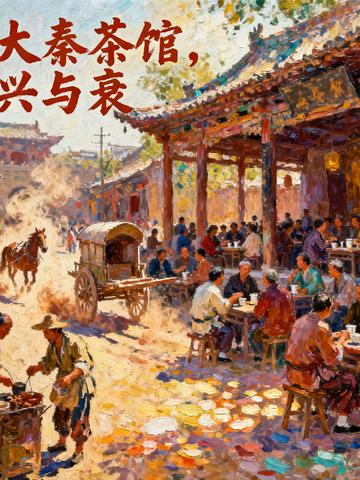
At the beginning, I just wanted to write a simple folk story - about the daily life of a small teahouse on the streets of Xianyang: the coarse pottery tea bowls when the garrison soldiers rested, the lively tea table where merchants exchanged news, and the fireworks of the neighbors gossiping. I did not intend to involve any grand history.
But as the writing goes on, the teahouse becomes "alive": from the thatched shed to the hanging wooden plaque of "Da Qin", the tea guests are now more officials who discuss laws, Confucian scholars who argue about ritual music, and alchemists who talk about immortal mountains; the tea soup soaked in has also changed from the simple fragrance of Fu tea to the smell of spices from the Western Regions, rumors of silk from the south of the Yangtze River, and news about the border garrison in the north of the Great Wall.
I suddenly realized that this was no ordinary teahouse. It was like a sponge, absorbing all the vitality of the Qin Dynasty - its liveliness reflected the gradual stabilization of people's livelihood after the unification of the dynasty; its desolation concealed the foreshadowing of the separation of people's hearts under harsh rule.
So I changed my mind: not only write folk stories, but also use this small teahouse to tell the story of the rise and fall of the Qin Dynasty. There is no complicated power struggle, just from the gathering and dispersing of tea guests, the hot and cold tea soup, and the thickness of the goods list, we can see how a dynasty went from "returning to the world" to "precarious".
Now this book is not only the story of the teahouse, but also a microcosm of the Qin Dynasty. Reading it does not require boring historical materials, but you can remember the most real history: the fate of all dynasties has always been hidden in the lives of ordinary people. This may be why it makes people unable to put it down - what you read is the teahouse of the past, but what you think about is the most practical truth in life.