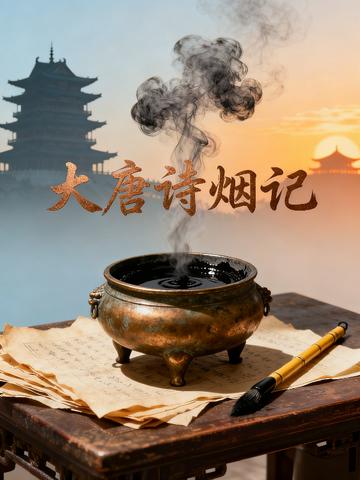
At the banquet at Prince Teng's Pavilion in the sixth year of Yonghui's reign in the Tang Dynasty, Su Yan, a historian's son, brought an ancestral bronze inkstone to the banquet - this square inkstone was the "key to the Tang Dynasty's cultural context" entrusted by Empress Changsun, and it contained the secret that "the destiny of poetry is the destiny of the country". He saw Wang Bo, a scholar from a poor family, counterattacking the powerful with the "Preface to Prince Teng's Pavilion", but he glimpsed the hidden worries of "Wu family seizing power" from the remaining ink of the poem manuscript, and since then he embarked on the road of "poetry smoke protection" spanning four dynasties.
In the early Tang Dynasty, he hid the manuscript of Chen Ziang's lonely and angry poems and copied Wang Ji's "Ambition" to protect the glimmer of new voices; in the wine shop of the prosperous Tang Dynasty, he helped Li Bai revise "Jianjinjiu" to avoid disaster, accompanied Du Fu to write "Military Chariots" to denounce harsh government, and Tong Gao Shi used "Yan Ge Xing" to hide military sentiments; during the Anshi Rebellion, he carried Du Fu's "Three Officials and Three Farewells" on his back. The blood-stained poems were able to survive the smoke and help Bai Juyi fight against corruption with "The Charcoal Seller"; in the separatist regime of the late Tang Dynasty, he formed an alliance with the "Three Sages of the Late Tang Dynasty" and built a "poetry post" and a "poetry copying workshop" to fight against the "poetry ban". Before Zhu Wen usurped the Tang Dynasty, he buried a bronze inkstone in the Shimai Pavilion, leaving the oath that "a thousand years later, inkstones will be inscribed with poems."
Thousands of years later, at the Songjiang archaeological site, the bronze inkstone shimmered, and Wang Bo's drafts, Li Bai's manuscripts, and Du Fu's blood manuscripts reappeared one after another. In front of the museum display cabinet, children recited poems and old men shed tears. The soul of Tang Dynasty poetry finally turned into everlasting poetic smoke in the passage of time.