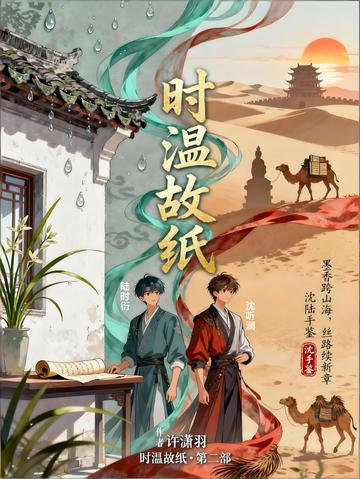
The second part of "Time and Time": Ink marks across mountains and seas
In the rainy season in the south of the Yangtze River, raindrops splashed tiny wet marks on the bluestone. The ancient book restorer Shen Tinglan was working on the manuscripts from the Qing Dynasty at his desk. The traces of wolf hair falling between the papers were the marks of tenderness between him and Lu Shiyan for decades. When the city library sent brittle ancient books from a church school in the Republic of China, this "old paper" carrying the history of modern education became a new topic for the two of them to protect. Shen Tinglan measured the fibers of the paper pages with his fingertips and prepared a special paste; Lu Shiyan silently took care of the logistics, from preparing the constant temperature and humidity box to putting a woolen shawl on him who was afraid of the cold. There was a tacit understanding in every detail of his daily life.
The wind in Dunhuang brought news about an old friend, and the rubbings of "Flying Flowers Presenting Flowers in the Sky" and the restoration plan of the Tang Dynasty Buddhist scripture fragments sent by Xiao Su led the two of them to the desert. Under the golden Populus euphratica forest, they took the "Silk Road Little Camel" to collect the cultural imprints of various countries. From the light and shadow of the murals in the Mogao Grottoes to the papyrus display cabinets in Cairo, Egypt, the restoration of ancient books is no longer a desk job, but has become a link between Eastern and Western civilizations. The restoration bench at the old hospital that has been with us for more than 20 years is covered with paste marks and knife marks, which bear witness to the warmth passed down from master to apprentice, and also carries the new mission of the "Online Ancient Books Exhibition" to allow culture to transcend time and space.
There are no ups and downs, heartbreaking twists and turns, only staying together in the fragrance of old paper and walking together in the wind and sand of the Silk Road. Shen Tinglan and Lu Shiyan used time as a pen, between the rain in Jiangnan and the sand in Dunhuang, to write the continuation of cultural inheritance, and also explained what is the "two-way perfection" - you guard the ancient books for thousands of years, and I guard you year after year, so that every remaining page will be rejuvenated and every love will have a home.