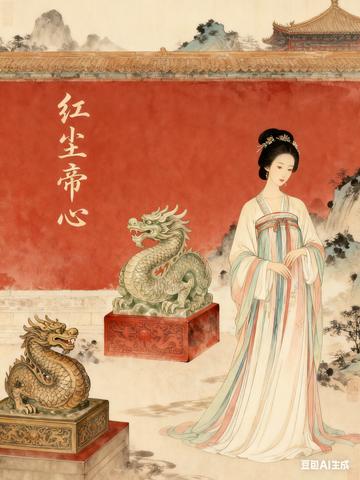
"The Heart of the Emperor" takes the rise and fall of the Liang Dynasty as the background, and outlines the legendary life of Cui Wan'er, a famous prostitute who rose from the quagmire to the peak, and then fell into silence with the collapse of the dynasty.
During the Taiping period of Daliang, Cui Shen, the Minister of Rites, was framed and exiled. Cui Waner, an infant, was rescued by loyal servants to the "Yanyu Pavilion" of Jiangnan Jiaofang Division. She received the teachings of Su Yuniang and imitated Master Li's character of "selling her art but not her body". She became famous in the south of the Yangtze River with her piano skills and talent, but her song "Bian Chen Sigh" made the prince Xiao Yu remember the secret. This story is purely fictional.
After she got her haircut, Cui Waner moved to Beijing and entered the "Zui Xian Tower" to play and sing to criticize the current ills. She met Xiao Yu again, who had been crowned king. She was trapped in a political vortex framed by powerful ministers, and became a pawn in the game like Chen Yuanyuan, but she used her wisdom to help Xiao Yu defeat the conspiracy and ascend to the throne. Xiao Yu defied all opinions and appointed her as queen. Cui Waner presented "Ten Strategies for Governing the World" in an attempt to restore the prosperous times. However, Xiao Yu gradually indulged in pleasure, the border was in crisis, and party disputes intensified. She was accused of being a "woman interfering in politics" and was left alone and helpless.
In the tenth year of Jinghe, the enemy country pressed the border. Cui Waner prevented Xiao Yu from escaping and asked for negotiations, but was detained. When she returned, Daliang was dead and Xiao Yu died of illness. In the end, she gathered her imperial bones and lived in seclusion in the south of the Yangtze River. She told the story of the rise and fall of the dynasty and personal ups and downs in "Sigh of the Red Dust", leaving behind the eternal controversy of "the character is better than Li Shishi, and the role is better than Chen Yuanyuan", which became a vivid footnote that reflects the transformation of an era from prosperity to decline.