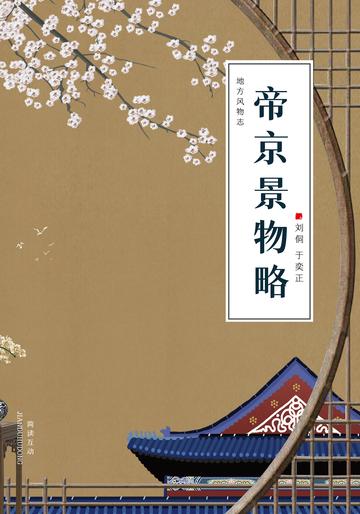
An Account of the Scenery of the Imperial Capital, published in 1635 during the Chongzhen reign of the Ming dynasty, is a work of cultural and geographical writing about Beijing and its outskirts. It was written by Liu Tong and Yu Yizheng, with Zhou Sun serving as editor. It is one of the most detailed records from the late Ming dynasty of Beijing's mountains, rivers, gardens, temples, bridges, terraces, springs, pools, seasonal customs, and other sights and traditions.
The book is clearly organized, with its volumes arranged by region, including the northern and eastern parts of the city, the south, and the Western Hills. It records palaces and temples, ancestral halls and gardens, famous springs and bridges, festivals and customs, lantern fairs and spring markets, as well as the everyday life of the city's residents. For many historic sites, such as Xiangshan Temple, Yuquan Mountain, Lugou Bridge, and Tanzhe Temple, it describes not only the scenery but also their history and setting.
The book's appeal lies in its style and perspective. Unlike the austere, rigid tone of official histories, it combines a literati's sensibility with the voice of a travelogue. The authors made visits to the sites and carefully considered their descriptions, bringing Beijing's gardens and landscapes, refined cultural pursuits, and bustling folk customs to life on the page. Readers can almost transmigrate back to the Ming capital, wandering through temple courtyards and narrow lanes, taking in the lively lantern fairs, and listening to temple bells at dusk. The book offers both historical depth and aesthetic pleasure.
In short, An Account of the Scenery of the Imperial Capital is both a treasure trove of urban geography and history and a literary travelogue of great merit. For anyone interested in Beijing's actual scenery, social customs, and literati life during the Ming dynasty, it is an essential work not to be missed.