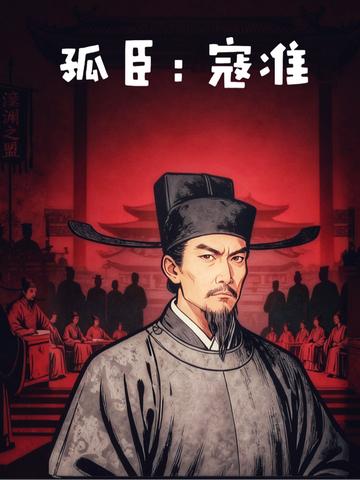
"Lonely Minister: Kou Zhun" is a historical novel based on the ups and downs of Kou Zhun, a famous official in the Northern Song Dynasty.
The story focuses on Kou Zhun, a complex figure with very different images in history books and folklore. He was a Jinshi in high school at the age of nineteen. He started out as the magistrate of Badong County in a remote rural area. He won love for his frugality, diligence and caring for the people. With his upright and even stubborn character, he dared to hold the emperor's sleeve in the court and force him to remonstrate, and eventually became the prime minister.
The novel takes "Lonely Minister" as the core and profoundly depicts Kou Zhun's loneliness and struggle in the center of power. He did not form any cliques or sides, and only cared about the country and the common people. Therefore, he was regarded as an alien by the entire officialdom. When the Liao army was pressing down on the country and the government and the public were in shock, he strongly opposed the idea of moving south, promoted Song Zhenzong's personal expedition, and led the signing of the far-reaching "Chanyuan Alliance" to turn the tide from collapse. However, his great achievements shocked the emperor and made countless enemies. He was immediately squeezed out by political opponents such as Wang Qinruo and Ding Wei. He worshiped the prime minister three times and was demoted three times. Finally, he died in distant Leizhou.
The whole book not only reproduces Kou Zhun's magnificent political career, but also goes deeper into his spiritual world and explores how a "lone minister" who adhered to principles in the cracks of feudal power and tactics used his life to interpret the belief of "regarding the people as his parents". His life was a collision between loyalty and power, a tear between ideals and reality. In the end, in the paradox of leaving a name in history and failing in reality, he created a spiritual monument that is both lamentable and extremely admirable.
Reader comments
It was a wonderful talk. I just heard Chapter 18, and I don't agree with some of the statements. When the courtiers talked about the emperor, they said: "Emperor Taizong..." Taizong is the temple name of the emperor, and he was given the title by his descendants after his death, so people at that time did not know that he was "Emperor Taizong."
Being upright and spreading positive energy is worth learning.
It was a wonderful talk. I just heard Chapter 18, and I don't agree with some of the statements. When the courtiers talked about the emperor, they said: "Emperor Taizong..." Taizong is the temple name of the emperor, and he was given the title by his descendants after his death, so people at that time did not know that he was "Emperor Taizong."
Being upright and spreading positive energy is worth learning.
I really like this book