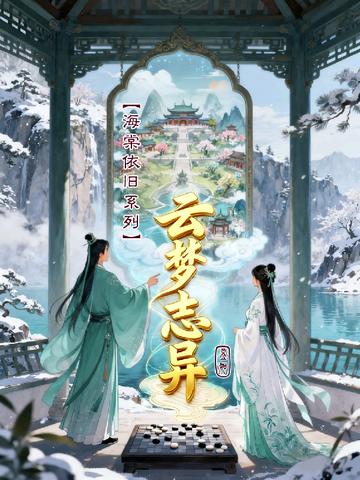
Begonia Remains the Same - Yunmengzhiyi
海棠依旧之云梦志异
- Status
- Completed
- Length
- 1.6M Words
- Genre
- Ancient Romance
- Subgenre
- Fantasy Romance
- Audience
- Female
- Updated
- 4mo ago
- Source
- Fanqie
Stats
5.8Score
260Chapters
1.1kReads · all time
Synopsis
Reader comments
In booklists 6
A Book with Good Writing, Beautiful Language, and Sentences That Can Be Included in Compositions.
There is description of the environment, mainly because I want to get high marks in the composition.
3.7MViews803Books1dUpdated
New Books Help Each Other.
Old guys, novices help each other
553.6kViews437Books13hUpdated

Are There Any Poetic and Picturesque Books?
I want to read a book similar to "Shi Yu Yi Yi".
389.4kViews66Books23dUpdated

I'm Already Numb. Can Anyone Recommend Some Interesting Books to Read?
Don't be stupid, funny jokes or romance novels are all fine
15.9kViews103Books2moUpdated

New Book, Mutual Review
I want to read a book similar to "The Witcher". Even if you click on it and take a look, give it some motivation! Please
8.9kViews61Books1dUpdated

No New Articles to Read, Book Shortage! ! !
I feel like the output of Tomato's new books has been a bit low recently.
1.9kViews26Books9moUpdated
"Begonia Remains: Clouds and Dreams Are Strange" is a romantic novel that combines oriental mythology, intangible cultural heritage, solar terms philosophy and fantasy adventure. The story begins with the ancient regret of "Begonia has no fragrance" and opens a magnificent legend that spans reality and illusion and restores the order of heaven and earth. This book aims to build a novel world view: it constructs the Yunmeng spiritual realm with "seasons" as the core, integrates the twenty-four solar terms, seventy-two seasons, flower trade winds and non-heritage inheritance into the world setting and plot advancement, showing the Eastern wisdom of the unity of nature and man.
This is a masterpiece that combines grand narrative with delicate emotions, fantasy imagination and realistic warmth. It has the romance and affection of fantasy romance, the pragmatism and passion of infrastructure literature, and the magnificent fantasy of mythology. The author uses delicate brushstrokes to outline the road to recovery in Yunmenglingland, allowing readers to not only feel the charm of ancient myths but also appreciate the preciousness of "living and working in peace and contentment" while following the protagonist in the process of saving the world. For readers who like fantasy romance, myths and legends, and infrastructure elements, this work is undoubtedly a reading feast not to be missed and worth reading carefully.
This romance novel really dug into my heart! There is no sweetness of industrial saccharin, nor cliché misunderstandings. The relationship between the male and female protagonists is more like a long and steady two-way rush. From the youthful trials on campus to walking side by side as adults, every eye contact and every subconscious protection reveals just the right amount of tenderness. The supporting characters are also too vivid to be like tools. The best friend's poisonous tongue assists and the brother's silly touch all add a bit of fireworks to the story. The most poignant thing is the details in the author's writing - an umbrella we hold together on a rainy day, warm candies in our pockets, a bowl of hot soup when we work overtime late at night. When these small and beautiful things are accumulated, they become the most touching form of love.
The writing style of this book is clear, graceful and hidden with mystery. The author is good at weaving dreams with the language of virtuality and reality. From the virtual illusion of "Flowers in the Mirror, Water and Moon" to the mythical time and space of Yunmeng Daze, the transition is natural and full of visual tension. The plot structure brings new ideas to the traditional fairy tale reincarnation narrative - high-tech "rhinoceros" glasses become a key prop to connect the two worlds. In the journey of reshaping the four seasons, it shows an aura of contemporary reconstruction of the "Book of Mountains and Seas"-style mythology system, which is worth recommending. Overall, this is a work that bravely weaves new narrative elements into the classical aesthetic tone. The plot based on the "Resurgence of Solar Terms" not only carries the heritage of Eastern philosophy, but also explores multiple propositions of memory, identity and responsibility within the framework of saving the world. Only some of the twists and turns are a bit presupposed, but the magnificent imagination and sincere emotions are enough to make people immersed in this Yunmeng Daze with the fragrance of crabapples.
[The love] shouldn't be in the tomatoes, the quality is too high. This should either be at the starting point or in Jinjiang. Listen to me, don't give tomatoes such a good quality chaff at a cheap price. From the beginning, the heroine is handsome and intelligent, and the vivid ancient scenes are described in detail, as if I have entered ancient times. Whether it is Yunmengze, please note that [Yunmengze] is a personal name, not a place name. There were no deer in it, no birdmen. The male protagonist Yun Mengze's words are also lifelike, no different from those of the ancients. It can be said that he has an elegant divinity. His words coupled with this wonderful ancient environment are simply immersive. Stop, stop, stop, these are not the point. What makes me excited is that this is a virtual world! The heroine can return to reality, not just to save the ancient world and become a heroine, but to join forces with powerful forces. This book is really good, come and read it!
When I opened this novel, the first thing that caught my eye was the wonderful setting of "science fiction breaks into mythology" - using "Rhizhao" smart glasses to connect to the ancient Yunmengze, giving the heroine Mu Luojun's "traveling from the present to the ancient" a unique texture of a cybernetic fairy. When the awakening of the "Dongxingxingjun" is intertwined with the salvation mission of the "Chief of Seasons", the story jumps out of the ordinary romance frame and unfolds a magnificent picture of reshaping the sun and moon and reviving the world. The author cleverly weaves the grand worldview of "reshaping the solar terms" into the delicate emotions of "reunion after a long separation", making the journey of saving the world particularly moving because of the old dream of Begonia. As a "potentially good book", it successfully blends the wonders of fantasy and the romance, and is worthy of readers who like both grand narratives and delicate emotions.
Who knows? Welding the twenty-four solar terms/intangible cultural heritage into a fantasy adventure novel, it is heart-breakingly romantic✨ "Begonia Still: The Legend of Clouds and Dreams" uses the ancient regret of "Begonia has no fragrance" as an introduction, and steps into the boundary between reality and reality - while entering the fantasy dungeon, while repairing the order of heaven and earth, the hazy atmosphere is directly filled. The most amazing thing is the "seasonal spirit realm" setting: the twenty-four solar terms, the seventy-two seasons, and the flower trade wind are not only the background board, but also the core rules for the operation of the world! Even the non-heritage inheritance follows the plot, hiding the Eastern wisdom of "harmony between man and nature" in a wonderful and natural way. It has the thrill of adventure and the warmth of culture, so you can go straight to the Eastern aesthetics party!
The delicacy and artistic conception contained in this novel are really moving. It is like a movie frame soaked in the clear halo of spring, slowly unfolding in slow motion - every detail is carefully crafted, as if you can touch the softness of the petals, and smell the intertwining fragrance of wine and flowers. The characterization of the characters is even more clear-cut. Between stillness and movement, solemnity and softness, the characters suddenly come alive, as if they are vividly written on the page. The emotional foreshadowing is particularly exquisite, echoing the regret of "Begonia has no fragrance", letting a hint of melancholy quietly seep into the warmth of spring. It is not strong, but it is like petals falling lightly on the shoulders. Although it is light, it leaves a mark. This kind of writing has both the texture of a movie and the depth of literature, which is worth savoring. Dear author, please continue to write with such spirit. We look forward to more touching chapters.
The regret of "Begonia has no fragrance" was originally an ordinary sorrow in the human world, but in the book "Begonia Is Still the Same", it becomes the key to the spiritual realm. Mu Luojun stepped into "Through the Mirror" with the help of "Xizhao" glasses, and met not only his old friend Yun Mengze, but also a fateful redemption that transcended reality and reality - when the identity of "Dongxingjun" was revealed, and when the crisis of annihilation in Yunmeng's spiritual realm emerged, personal thoughts and the existence of heaven and earth were suddenly intertwined, making this work break out of the framework of ordinary fantasy novels from the beginning. The author takes "solar terms" as his core, and melts his intangible cultural heritage, poetic soul, and strange beasts into his writing. From the "burning clouds and verdant" begonias in the realm of mirror flowers, water and moon, to the "clouds and mist like milk" Zhenlong Pavilion in the realm of clouds and dreams, from the elegance of reciting the three seasons of flower letters, to the fantasy of encountering the sun as fire and looking at comfort as frost, every scene is like a combination of meticulous painting and freehand blanks. It reads like a scroll, and even the words are soaked in fairy spirit and warmth. What's even more rare is that beneath the magnificent fantasy lies a deep reflection on "order" and "guardianship"—the decline of the spring god Jumang and the dilemma of craftsmen and craftsmen all coincide with the philosophy of "disorder leads to death", making the road to redemption not only full of fantasy, but also with a heavy sense of mission. However, the difficulties of this way of writing are also very obvious. First, the "solar terms" system is complex, and it must not only conform to the connotation of traditional solar terms, but also be tied to the crisis of the spiritual realm and the growth of the characters. If you are not careful, it will appear blunt and disconnected; second, the virtual and real scenes switch frequently, and the romance of the mirror flowers and moons and the vastness of the cloud dream spiritual realm need to be distinguished in texture. If the details are not properly controlled, it is easy for readers to fall into cognitive confusion; third, the integration of poetry, intangible cultural heritage and other elements needs to be natural, and excessive stacking will destroy the narrative rhythm and reduce it to "show off skills". In subsequent creations, we may also face greater challenges, but I hope the author can grasp them well. Of course, they may just be some of my worries. For example: how to avoid duplication in the process of "reshaping the solar terms", so that each step of redemption has unique conflicts and highlights; how to balance personal emotions (the bond between Mu Luojun and Yun Mengze) and the grand narrative (saving the spirit tribe) to avoid focusing on one and losing the other; more importantly, we need to be wary of overloading fantasy elements, so that the core themes of "guarding" and "redemption" are not obscured by complicated settings? These all need to be done step by step and created slowly. Of course, as long as we stick to the original intention of "using emotion to control scenery and using scenery to complement emotion", this work will definitely shine with more moving brilliance in the intertwining of fantasy and reality.
Following Mu Luojun's footsteps and stepping into the world of "Begonia Remains: Strange Dreams in the Clouds", one is drawn into a magnificent legend that spans reality and fiction by the eternal elegance of "Begonia has no fragrance". The author takes the seasons as his bones and cleverly builds the spiritual realm of clouds and dreams, turning the flow of the twenty-four solar terms into pulses and the seventy-two periods into rhyme. The flower trade wind carries the warmth of intangible inheritance, and spreads the Eastern philosophy of the unity of nature and man during the protagonist's adventure to restore the order of heaven and earth. There is a romantic undertone of myth between the lines, and the everlasting luster of civilization is everywhere in the writing. Reading is like a refreshing breeze, and the paper is full of fragrance.
Reading is about time. This is true! In this cold winter, people are lazy and have many things to do. I came across this book, and I was very interested. I curled up in bed, listened and read, which was really pleasant. The language of the work is refreshing and simple, the plot is vivid and tortuous, the story advances layer by layer, and the characters are lifelike. Especially the details are real and the emotions are delicate. You can't help but be immersed in it and can't stop. Good books are like this, nourishing the heart. So I forwarded it to my circle of friends, recommended it, and praised it. I would like to pay tribute to the author for this first review! After further review, it is still five stars!
Still unfinished! It's very beautiful, the author combines knowledge and interest, and the plot is fascinating. The writing is beautiful and smooth, full of classical poetry. The readers are presented with Yunmeng Lingjing, which focuses on reconstructing the four seasons. Cloud God and Dongxingjun jointly protect the dreamland of the Spirit Clan. The twenty-four solar terms, seventy-two seasons, flower trade winds and intangible cultural heritage techniques are cleverly integrated to show a strong cultural heritage.
The opening chapter starts with the Flower Festival, weaving the elegance of traditional folk customs and the melancholy of personal memories in a delicate and moving way. Mu Luojun's explanation of the ritual is like a spring breeze, which not only popularizes the cultural significance of the Flower Festival and the Twenty-Four Flower Trade Winds, but also reveals an unfinished love affair with his old friend Yun Mengze through the contrast between the past and the present under the crabapple tree. Da Da uses images such as "sprinkled gold paper" and "ice jade bracelets" to highlight the classical artistic conception, and also uses "portable MOOC equipment" to cleverly connect ancient and modern times, allowing the heaviness of intangible cultural heritage and the lightness of youthful regrets to reflect each other. The most touching thing is the sentence "Begonia is still there, but the old friend returns without seeing her" - in the rigorous knowledge of solar terms, there are hidden poems about commitment, growth and longing of a generation. Every chapter is like reading a beautiful prose poem. The writing style is so beautiful.
"Begonia Remains: Strange Dreams of Clouds" combines elements of ancient romance, reunion after a long absence, and time travel to other worlds. Emotion and fantasy are intertwined, with the regret of "Begonia has no fragrance" and the longing for the old friend as the emotional core, closely connecting personal emotions with fantasy adventure. It has constructed elements such as "Yunmeng Lingjing", "Four Seasons" and "Spirits of Spirits", and set up fantasy backgrounds such as "Reincarnation of the Cave Star Lord" and "Crisis of Destruction of the Spiritual Realm". It is logically self-consistent and full of imagination. At the same time, the transformation of the protagonist from an ordinary person to the "Master of the Season" shows the growth arc of "ordinary people taking on the mission" and conveys the positive theme of "responsibility and responsibility". It is highly recommended!
At a time when fantasy and romance themes are concentrated on "upgrading and fighting monsters", this book is amazing. It uses traditional culture as the bones and fantasy imagination as the flesh. It deeply binds the twenty-four solar terms, classical imagery and the world view of the fairy tale, and has carved out a unique path that combines cultural texture and narrative tension. The author's use of traditional culture is by no means a simple pile of symbols, but dismantling it into the core logic of the operation of the worldview. In the story, the rise and fall of the "Yunmeng Spiritual Realm" is closely tied to the twenty-four flower trade winds - the "east wind thawing" at the beginning of spring corresponds to the first sprouting of vegetation in the spiritual realm, the "Tongshihua" of the Qingming Festival is related to the flow of the power of the gods, and the "jackal is a sacrificial beast" of frost heralds the dormant crisis. When the spiritual realm falls into decline due to "seasonal disorder", the protagonist's "redemption mission" is no longer an empty fairy mission, but transformed into specific actions of "restarting the Yang Qi of the Beginning of Spring" and "restoring the Qingming Yuze". Each step of advancement coincides with the natural rhythm of traditional solar terms, making cultural heritage an endogenous driving force to promote the plot. Even more ingenious is the creative reconstruction of classical imagery. "Begonia has no fragrance" is a classic regret written by literati, but the author transforms it into an emotional anchor connecting reality and the spiritual realm. In reality, the protagonist is obsessed with "looking for fragrance", which in the spiritual realm turns into a fantasy scene of "Begonia fragrance and snow sea". The fragrance and lack of fragrance between reality and reality not only echoes the emotional main line of "making up for regrets", but also coincides with the image extension of "Tangdi's Flower" in the Book of Songs. In addition, the recitation of "Nine Songs: Lord of the Clouds" becomes the key to awakening the gods. The name "Rhinoceros Zhao" comes from the ancient legend of the "Rhinoceros Horned Candle Monster". These classical cultural elements have been translated into fantasy, which not only retains the elegance of Eastern aesthetics, but also gives it a "touchable and interactive" fairy-tale quality, allowing readers to unconsciously touch the texture of traditional culture while immersed in the story. The writing style is grand, and the author uses "poetic narrative" to connect culture and stories. When describing the Hua Chao Festival, "The vermilion altar reflects the trees full of pink tangerines, the shaman holds branches and drinks spring wine, and the fallen flowers rustle and wet their clothes with the music of "Zhao Yu"". In just a few words, the ritual sense of traditional sacrifices is blended with the fantasy sense of the spiritual world; when depicting the crisis of disordered solar terms, "In the season that should have awakened the thunder and thunder, the spiritual realm is filled with frosty snow, freezing the budding grass buds into small blue-white curls." The concrete description of abnormal solar terms not only conveys the urgency of the crisis, but also implies the traditional philosophy of "conforming to nature." This writing method of "taking culture as the bone and narrative as the flesh" adds a layer of weight and warmth of traditional culture to the book in addition to the fantasy story.
'Rhinoceros Photo' opens up a fantasy world, Haitang meets Yunjun – science and technology blends ancient times with myths, and the setting hits the mark! The atmosphere of the Flower Festival is amazing, and my fingertips feel like they are smelling of flower petals. The commander of the festival is in the realm of saving spirits. He is immortal and easy to eat, so he chases him!
A reunion spanning virtuality and reality, a love entangled in the past and present life, the heroine, with a modern body, inherits the fate of Xingjun, and embarks on a journey to reshape the world in the crisis-ridden Yunmeng spiritual realm. From regret and longing to the important task of saving the world, Mu Luojun's adventure in the Yunmeng spiritual realm is both growth and pursuit.
There is no industrial saccharine in this novel, only a long and steady two-way journey. From their youthful trials on campus to walking side by side as adults, every look in their eyes reveals tenderness. The supporting characters are also vivid, with the best friend's poisonous tongue assisting and the brother's silly finishing touch, full of fireworks. The most touching things are the details: the umbrella we hold together, the candies that keep us warm, the hot soup late at night. When these small and beautiful things are gathered together, they become the most moving look of love.
The title of the catalog surprised me, as did the opening chapter. This kind of writing style and novels with a bit of ancient flavor can be regarded as a breath of fresh air in the novel world where Shuangwen is booming today. I like it very much and highly recommend it!
This setting is really amazing! He used future high-tech glasses to enter the ancient fantasy world he built, only to find that the game came true and he was actually the reincarnation of Big Dipper, and the old friends he reunited with had become gods in the clouds. When the illusory world overlaps with the crisis of annihilation, an epic rescue involving the solar terms of heaven and earth begins. The author's writing style is exquisite, and he skillfully stitches together new mythology and science fiction concepts to reshape the four seasons, without losing the delicate depiction of the characters' emotions. This growth that spans the virtual and the real is particularly worth pursuing.
The characters in this book are vivid and the writing is very delicate. Of course, if you are pursuing the ultimate coolness and fast pace, you may need a little patience to adapt to it. But if you are like me and occasionally want to escape the hustle and bustle of reality and gain an immersive experience in a story with cultural heritage, intellectual confrontation, and fatalistic emotions, then this book is definitely your cup of tea. This is a piece of work that can calm you down and amaze you. It allowed me to see another possible height of online novels, which not only have good stories, but also have a profound cultural soul. The author should update it soon. I want to see the follow-up plot.
"Begonia Remains: Strange Dreams in the Clouds" is a stunning work that perfectly integrates oriental mythology, intangible cultural heritage and romantic fantasy! The author uses the regret of "Begonia has no fragrance" as a guide to unfold a picture of Yunmeng where virtuality and reality are intertwined. The writing style is delicate and picturesque, and the artistic conception is profound and grand. It contains both the philosophy of seasonal solar terms and the waves of mythical reincarnation. The story injects novel settings into the classical charm, the emotions are sincere and moving, and the layout is broad yet gentle. If you also love fantasy romances that are full of cultural heritage, elegant writing style and full of imagination, this book is definitely an immersive journey not to be missed.
The setting is very novel, integrating the twenty-four solar terms with mythology, the entanglement of past and present lives, the integration of modern technology, and the literary foundation is profound. Both the plot and scene description are very delicate. The protagonist is not only intelligent but also interspersed with love entanglements. It is a very good book and worth recommending.
"Begonia Still: Clouds and Dreams" is a masterpiece of fantasy romance that combines modern technology with ancient mythology. It stands out among similar works with its unique creative ingenuity. The most eye-catching aspect of the work is the bold integration of modern technological elements such as "Rhinoceros" smart glasses with ancient mythological settings such as the reincarnation of the Big Dipper and the spiritual realm of Yunmeng, breaking the boundaries between fantasy and science fiction. The design of the "Through the Looking Glass" virtual fantasy makes the interweaving of reality and myth appear natural and novel. In terms of narrative, the novel opens without any delay, quickly revealing the truth about the life experience of the protagonist Mu Luojun, and at the same time throwing out the crisis of annihilation in the Yunmeng spiritual realm where the sun and moon are disrupted and the spiritual energy is exhausted, allowing readers to be instantly immersed in the plot. The infiltration of Chinese aesthetics makes the story more charming: the chapter titles are embedded with classical images such as the goddess of spring, the soul of the flower, and the soul of the flower. The main line of "reshaping the four seasons" is closely linked to the traditional seasonal culture, and the lines are full of oriental artistic conception. What's even more rare is that the protagonist's road to salvation did not take the shortcut of "cheating", but chose to visit Yunmeng City, Fenghou Village and other places to experience the suffering of the people. This "down-to-earth" shaping added real warmth to the grand theme of salvation, and also made Mu Luojun's character more three-dimensional. As a serial work, the creativity and narrative skills it has demonstrated are enough to make people look forward to the follow-up plot's in-depth exploration of the road to redemption in Yunmeng's spiritual realm.
This novel is so good, like an exquisite jade carving that gathers craftsmanship, exquisite and radiant. At the same time, I feel the unremitting efforts, passionate creation and unparalleled inspiration infused between the lines. Great author, come on!
This novel is really good. Both the author's writing and the character creation are excellent. I must highly recommend it! This is not only a story about love, but also an epic about fate, growth and counterattack. If you also like works with grand layouts, rich characters, and touching emotional lines, this book is definitely worth reading!
The author's writing style is really good, especially the description of the background is extremely detailed, and you feel as if you are immersed in the scene while reading. At the same time, the characterization of the characters is extremely rich, not only the personality of the protagonist is very clear, but also the character characteristics of the supporting characters can make people have a deep impression. It is very good, recommended!
It is really a very good novel. I have never seen such a good one. The writing style, setting, and unique understanding of everything in the world are all unmatched. The author's literary and philosophical qualities are very high, and his knowledge reserve is also very rich. Come on, author, such a good book will become popular just around the corner. Leave a mark first, just like Liu Ming, who will be an old fan by then. Author, we like you, I will always follow you [Love] [Love] [Love]
"Begonia Remains: Strange Dreams in the Clouds" breaks out of the ordinary fantasy narrative. The plot is based on "solar terms", interweaving the reunion of old friends in the mirror and the moon in the mirror with the crisis of annihilation in the Yunmenglingland. Intangible cultural heritage ingenuity and poetic soul are integrated into every adventure. The switch between virtual and real not only hides the nostalgia for the past, but also reveals the magnificence of oriental mythology. This kind of setting makes nostalgia no longer just indulgence, and fantasy is no longer just about showing off skills, but becomes the force that promotes redemption. It reads like a picture scroll intertwined with meticulous brushwork and freehand brushwork.
The author skillfully combines classical aesthetics and suspense narrative, and uses the restoration of cultural relics as a guide to uncover love, hate and conspiracies that have been dusted by time. The story unfolds slowly like a meticulous scroll, with solid research and profound artistic conception. In the interweaving of ancient epigraphic books and legends of legends, a dialogue across time and space is completed. It is not only an intellectual puzzle, but also an affectionate review of cultural heritage and historical memory. The writing style is elegant and full of ancient charm, which is worthy of careful reading.