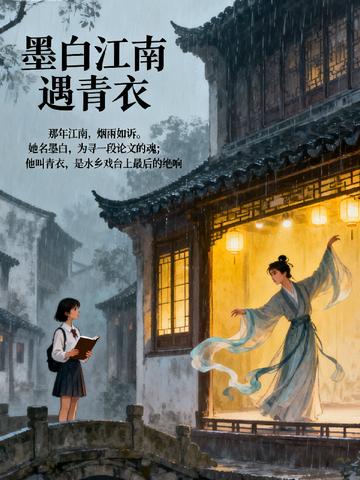
That year in Jiangnan, the misty rain fell like a plaintive song.
Her name was Su Mobai, and she sought the soul of a thesis. His name was Qingyi, and he was the final, fading note on the water town’s opera stage.
Su Mobai, a young woman studying in Shanghai, travels to her grandmother’s ancient Jiangnan town to complete her thesis on classical aesthetics. She expects an ordinary academic trip, until one rainy night, she pushes open the door of Yunhua Theater and meets a man onstage known as “Qingyi.”
His water sleeves sweep through the air, his eyes full of feeling. He is Shen Qingyi, a celebrated Kunqu opera star who captivates all who see him, and an aloof, enigmatic figure in the heart of the old town. He brings Du Liniang’s lovesickness and Yang Guifei’s drunken grace to life, yet no one understands the lonely heart beneath his painted face, burdened by the opera troupe’s fortunes and struggling against the tide of the times.
One performance, one tear, one meeting of eyes. She offers him a note filled with understanding; he answers with a dance of his water sleeves, performed for a kindred spirit alone. From their chance encounter by the stone bridge to their deep conversations in the rehearsal hall, Mobai gradually comes to understand the integrity and perseverance behind his art, and touches the tenderness hidden deep within him.
Yet peaceful Jiangnan is no paradise beyond the reach of the world. A wave of “reform” blowing in from the provincial capital, bearing scrutiny and doubt, is about to engulf the ancient theater. As outside pressure, the troupe leader’s compromises, and the naive affections of those around them all come to bear, Mobai chooses not to remain a quiet spectator. With her knowledge and wisdom, she stands firmly by his side, and together they face a trial that will determine whether their art survives.



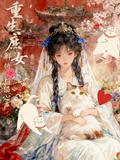



"Biography of Kun Opera" outlines the situation of the art garden in Suzhou in the Republic of China with delicate brushstrokes. When Kun Opera was surviving and dying, Shen Qingyi and Su Mobai adhered to their original artistic aspirations of "singing opera for the people" and launched a battle to protect culture with the forces of capital. The work cleverly interweaves the legend of the Liyuan Garden, the love and feud between aristocratic families and the changes of the times. In the plot of the reunion of the hosta and the restructuring of the theater troupe, it shows the endless development of traditional culture in the rapid current of the times. The diction is elegant and subtle, and the narrative is relaxed and restrained. It not only shows the elegance of Kun Opera, but also shows the importance of cultural inheritance.
The writing is exquisite and the descriptions are particularly picturesque! It makes people feel the beauty immersively! 😘😘😘