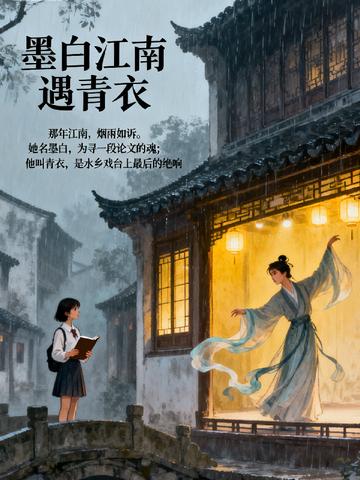
That year in the south of the Yangtze River, there was mist and rain.
Her name is Mo Bai, looking for the soul of a piece of essay; his name is Qing Yi, and he is the last voice on the water town stage.
Su Mobai, a female student in Shanghai, set foot on the ancient town in the south of the Yangtze River where her grandmother lived to complete her thesis on classical aesthetics. She thought it was just an ordinary academic trip, until that rainy night, she opened the door of Yunhua Theater and met the man named "Qing Yi" on the stage.
The water sleeves are lightly tossed, and the eyes are flowing. He is Shen Qingyi, a famous actor who confuses all living beings on the Kunqu Opera stage, and is also a cold and lonely mystery deep in the ancient town. He brought to life the madness of Du Liniang and the drunkenness of Concubine Yang, but no one could understand the lonely heart under his play that was burdened with the rise and fall of the troupe and struggled in the torrent of the times.
A scene, a tear, a meeting of eyes. What she handed over was a note full of understanding, and what he responded to was a song of water sleeves that danced just for his soulmate. From the chance encounter by the stone bridge to the in-depth conversations in the rehearsal hall, Mo Bai gradually understood the character and perseverance behind his art, and also touched the unknown softness deep in his heart.
However, the tranquil Jiangnan is not a paradise. The "innovation" wind blowing from the provincial capital, bringing scrutiny and questioning, is about to sweep over this ancient stage. When external pressure, the class leader's compromise, and the naive love of others came one after another, Mo Bai did not choose to be a quiet spectator. With her knowledge and wisdom, she stood firmly by his side and faced this challenge together that was related to the survival of art.
Reader comments
"Biography of Kun Opera" outlines the situation of the art garden in Suzhou in the Republic of China with delicate brushstrokes. When Kun Opera was surviving and dying, Shen Qingyi and Su Mobai adhered to their original artistic aspirations of "singing opera for the people" and launched a battle to protect culture with the forces of capital. The work cleverly interweaves the legend of the Liyuan Garden, the love and feud between aristocratic families and the changes of the times. In the plot of the reunion of the hosta and the restructuring of the theater troupe, it shows the endless development of traditional culture in the rapid current of the times. The diction is elegant and subtle, and the narrative is relaxed and restrained. It not only shows the elegance of Kun Opera, but also shows the importance of cultural inheritance.
The writing is exquisite and the descriptions are particularly picturesque! It makes people feel the beauty immersively! [Blow a kiss][Blow a kiss][Blow a kiss]


"Biography of Kun Opera" outlines the situation of the art garden in Suzhou in the Republic of China with delicate brushstrokes. When Kun Opera was surviving and dying, Shen Qingyi and Su Mobai adhered to their original artistic aspirations of "singing opera for the people" and launched a battle to protect culture with the forces of capital. The work cleverly interweaves the legend of the Liyuan Garden, the love and feud between aristocratic families and the changes of the times. In the plot of the reunion of the hosta and the restructuring of the theater troupe, it shows the endless development of traditional culture in the rapid current of the times. The diction is elegant and subtle, and the narrative is relaxed and restrained. It not only shows the elegance of Kun Opera, but also shows the importance of cultural inheritance.
The writing is exquisite and the descriptions are particularly picturesque! It makes people feel the beauty immersively! [Blow a kiss][Blow a kiss][Blow a kiss]