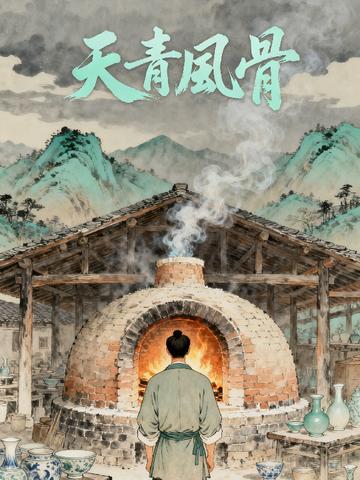
In the beacon fire at the end of the Qing Dynasty and the beginning of the Republic of China, the pine smoke of Jingdezhen Long Kiln was cooling down inch by inch. Shen Zhengtang, the last inheritor of azure glaze in this thousand-year-old porcelain capital, guarded the secret recipes of Chai Kiln and Yongzheng Imperial Kiln left by his ancestors, but he was thrown into the most chaotic era - Western machine porcelain rolled in with silver coins, and the ancient methods were swept away. The craftsmanship reduced the porcelain pieces to pieces; the apprentices who returned from studying abroad shouted "Industry saves porcelain" and turned around and joined the assembly lines of foreign companies; the fellow villagers who grew up relied on reselling ancient porcelain to cling to the warlords, and pressed their guns against the kiln door to bake "porcelain for the powerful."
When the fire in the kiln was about to go out, the old mother, who had kept the secret recipe all her life, threw herself into the kiln along with the notes, leaving only one sentence: "If the porcelain is broken, it can be reburned. If a person loses his soul, everything he burns will be dirt."
From rejecting foreign merchants and fighting against warlords, to watching the dragon kiln fall into ruins, Shen Zhengtang finally understood: the "vitality" of azure glaze never lies in the secret recipe of the glaze, but in the strength when kneading the clay, the look in the eyes when looking at the fire, and in the hearts of everyone who is willing to knead the clay into shapes. On the eve of the Anti-Japanese War, he set up a small clay kiln by the Changjiang River and taught the fleeing children how to pull bricks. His hands stained with porcelain clay touched the handprints of his ancestors on the kiln bricks - those traces that were darkened by water would eventually shine light blue again in the new temperature of his palms.
This is not a story about a craftsman keeping porcelain, but about a man picking up the weight of the word "inheritance" from the fragments of civilization.