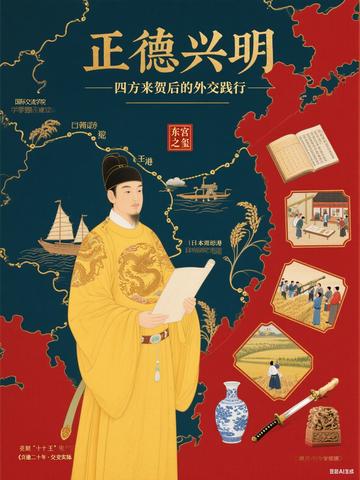
During the Zhengde period, the Ming Dynasty was at the crossroads of changes and challenges - piracy and smuggling were rampant on the coast, local officials were corrupt, people's livelihood was in decline, foreign forces were eyeing it, and internal conflicts between clans and business gangs were surging. A practice of governing the country that began with the southern tour kicked off the "Xingming" of the Ming Dynasty.
Emperor Zhu Houzhao personally led the navy to clean up the sea frontier, from the pirate siege in Quanzhou Port to the smuggling investigation and prosecution in Guangzhou Prefecture, using iron-handed measures to rectify government affairs and standardize trade; he went deep into the Jiangnan water towns, built the Qiantang River embankment, cleared the siltation of the West Lake, exempted and exempted taxes in disaster areas, and used people's livelihood measures to alleviate the suffering of the people. The prince, Zhu Zaihan, first became involved in government affairs during his southern tour. From settling land disputes in Suzhou and relieving snow disasters in Shandong, he presided over the compilation of the "Da Ming Dian" and improved the legal system, and gradually grew into a capable successor to the governance of the country.
As the Ming Dynasty's national power grew, envoys from all over the world came in droves - North Korea sought Confucian enlightenment, Japan sought technical exchanges, Siam hoped for agricultural cooperation, and European countries hoped for trade exchanges. With the principle of "mutual benefit and win-win", the prince led a delegation to visit three countries in East Asia to promote the implementation of double-cropping rice planting, blue and white porcelain techniques, and fireproof transport cabin technology; he also prepared to establish an international exchange academy and build a "core circle - cooperation circle - exchange circle" diplomatic pattern, so that the silk, porcelain and culture of the Ming Dynasty could be spread to all countries along the maritime routes.