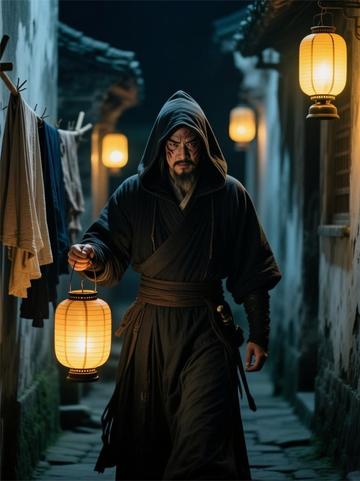
"An Examination of Bad Persons in the Tang Dynasty"
Those who are bad men are also the officials assigned by counties and counties in the Tang Dynasty to investigate. He is neither an official nor a slave, he wanders in the gaps between the laws, and is in charge of patrols, criminal cases, and investigations. Its name first appeared in Wei Shu's "New Records of Two Capitals", which states: "There are bad people in Chang'an County, and the officials call them 'bad', saying that they are illegal, so they are named after them." This is based on his technique of using evil to control evil, and using old evil to organize new prisons.
The undesirable people are all selected from the unruly people in the market, some have criminal records, or are involved in the underworld. The leader is called "Bad Commander", who is in charge of all the members and is directly subordinate to the county captain. Whenever there is a serious case of robbery, he is ordered to investigate, hide the traces, catch the thief and detect the fraud, which often has miraculous results.
Zhang Jue of the Tang Dynasty records his deeds in "Chao Ye Qian Zai" in particular detail:
"Chang'an is a bad handsome man with a shrewd nature. From time to time, a palace official was robbed and killed. Chang deceitfully claimed that he had "got the thief's leg", so that all the officials went to the city to recognize him. The thief surrendered in fear, and the county became famous."
This shows that he is good at using subterfuge and psychological skills to solve crimes, not just relying on force.
There are also fragments of the Dunhuang posthumous book "Anxi Banji" which contain:
"Instruct the bad guy so-and-so to interrogate the main culprit of the robbery..."
This proves that this system was not only practiced in the capital, but also spread throughout the border states of the Western Regions, and was an essential tool for basic criminal investigation in the Tang Dynasty.
However, although his position was important, his position was ultimately insignificant, and he was ashamed to be ranked in the same category as the scholar-bureaucrats. However, without this generation, the county government would not be able to eliminate traitors and bring peace to the countryside. Therefore, it is said: Public security in the Tang Dynasty was partly due to subordinate officials; half of the ability of subordinate officials was due to their faults.