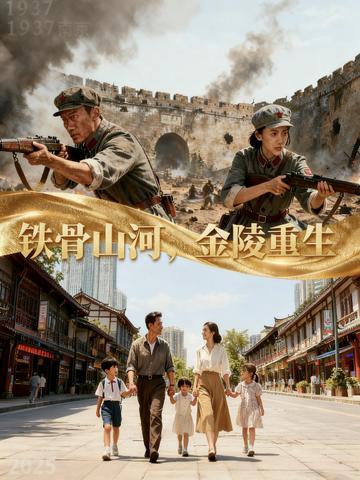
Zhao Yang, a graduate student in the History Department of Sichuan University from Qingbaijiang, Chengdu, was traveling to Nanjing with his girlfriend Li Xiaomei from Jinjiang District. At the Memorial Hall of the Victims of the Massacre, they accidentally traveled to December 13, 1937 - the day when the Japanese army captured Nanjing. After witnessing the bloodshed and despair of the city massacre, the two gained the ability to "rebirth": they died tragically at the gunfire of the Japanese army while saving civilians in the first battle, and the second time they were reborn, they used foreigners in the concession to temporarily avoid risks, but they experienced the pain of war more painfully.
In order to end their suffering, they fled Nanjing and found the Eighth Route Army. Zhao Yang relied on the historical notebook he carried with him to transform the Japanese military deployment, battle timeline and other modern historical achievements into anti-Japanese intelligence, helping the troops avoid traps and accurately ambush; Li Xiaomei transformed in the flames of war and grew into a backbone of medical care to save lives and heal the wounded. After eight years of fighting side by side, they finally witnessed the Japanese surrender in August 1945, allowing the land of Jinling to see light again.
At the moment of victory, the power of time and space sends the two back to modern times. Bearing the imprint of the Anti-Japanese War years, Zhao Yang completed an academic thesis integrating personal experience, and Li Xiaomei transformed into a grassroots nurse to convey warmth. After that, the two got married, and their children were named "Nian'an" and "Yining" to remember the history. They often took their children to revisit Nanjing - amidst the prosperity of the Qinhuai River and the solemnity of the memorial hall, the feelings of family and country and the belief in peace that transcend time and space can be passed down in the new era.