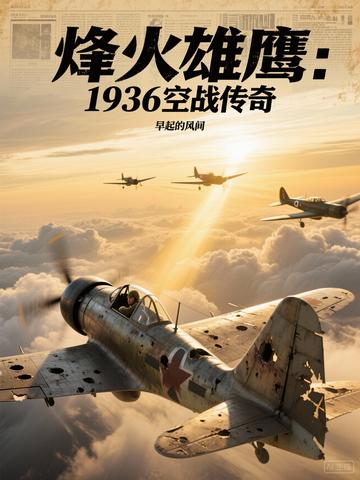
Ace pilot Lin Guozhong accidentally time-traveled to 1936 during a military exercise. Relying on the propeller aircraft experience accumulated in the simulator, he flew a Hawker III to shoot down a Japanese reconnaissance aircraft. He became famous in the first battle and stayed in the team. When the Battle of Songhu began, he led his team to fly Hawker III in a deadly battle with the Japanese Type 96 fighter planes. He used modern tactics to save his comrades, but he also witnessed the sacrifice of his comrades and the chaos of corruption in military supplies.
After the fall of Nanjing, Lin Guozhong contacted him and decided to stay undercover. With his outstanding air combat skills, he shot down the Japanese ace and was awarded a medal. He took the opportunity to take control of the newly purchased fighter planes, secretly instigated pilots and mechanics, and hoarded fuel parts. Faced with the close surveillance and probing by military special agents, he faced dangers several times but still firmly pushed forward the transfer plan.
In 1939, Lin Guozhong used the opportunity of being transferred to the defense to force a breakout, broke through the interception, and reached the border area after a bloody battle, becoming the core of the first Air Force "Eagle Brigade". After that, he led his team to build a secret airport in the Taihang Mountains, overcome supply difficulties, and used guerrilla air combat to support operations behind enemy lines.
From the lone eagle in Hangzhou to the sword in the sky, he created an anti-Japanese legend that spans time and space with his strong and courageous character and modern air combat concepts.
Reader comments
There are very few anti-war aerial combat articles, which are very good. At that time, most of the pilots in the government were overseas Chinese who had returned to the country and attended higher education institutions such as Tsinghua University and Nankai University. The average age of sacrifice was only 23 years old. No one surrendered, no one was captured, and they died heroically. J-10, J-11, J-15, J-16, J-20, J-35, J-36, J-50….
Not bad, good, tastes great
Super nice
The plot is gripping
Not bad, the aerial combat scenes are described very well.
This book is very practical. It describes the heroic spirit and indomitable spirit of the soldiers of the motherland. Praise for the heroes!
There are very few anti-war aerial combat articles, which are very good. At that time, most of the pilots in the government were overseas Chinese who had returned to the country and attended higher education institutions such as Tsinghua University and Nankai University. The average age of sacrifice was only 23 years old. No one surrendered, no one was captured, and they died heroically. J-10, J-11, J-15, J-16, J-20, J-35, J-36, J-50….
Not bad, good, tastes great
Super nice The plot is gripping
Not bad, the aerial combat scenes are described very well.
This book is very practical. It describes the heroic spirit and indomitable spirit of the soldiers of the motherland. Praise for the heroes!